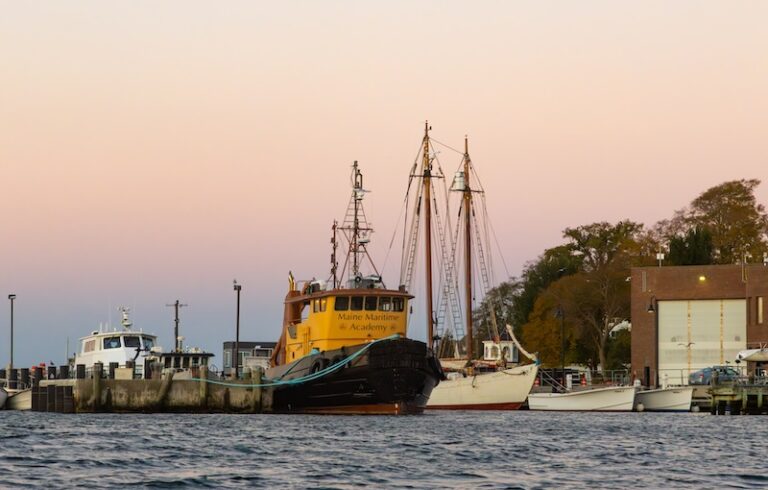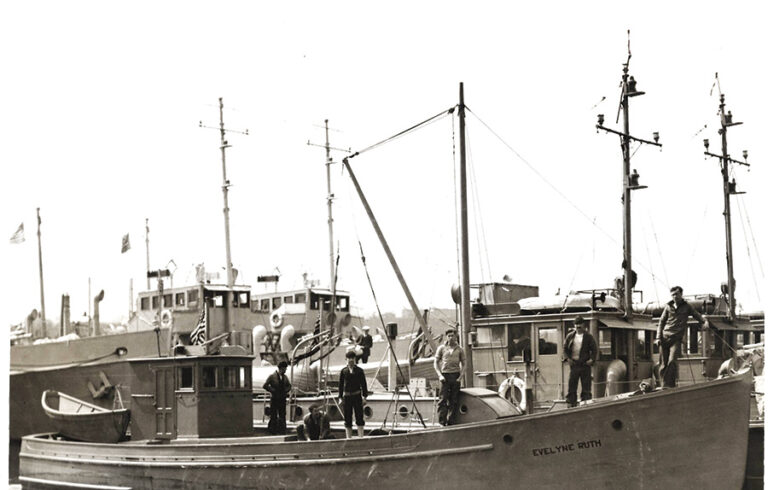
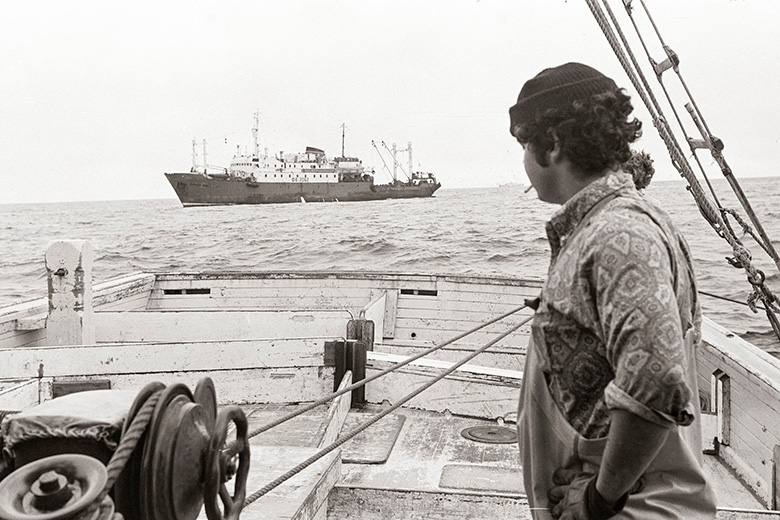
When Cape Porpoise gillnetters returned to the sea to haul their gear up during the week of August 11, 1974, all they found were a few shreds of their nets and some end-markers. They were fishing on Jefferies Ledge, 30 miles off southern Maine and New Hampshire.
That week, 42 foreign fishing vessels were documented on Jeffries. The Maine gillnetters were trying to make a living in 40-foot boats alongside hundreds—often as many as 300—of the most modern fishing vessels in the world that were on New England fishing grounds each month. These weren’t small boats. As an example, the 335-foot Soviet Atlantik III class trawlers had 4,000 horsepower, could travel more than 17 knots, could catch up to 143,000 pounds of fish in a three-hour tow, and could process and freeze 264,600 pounds of fish a day. No gulls followed these boats—anything they couldn’t process for food went into fishmeal.
The boats came from the Soviet Union, East and West Germany, Poland, Romania, Japan, France, Italy, Spain, and other countries. The fleets included factory trawlers, medium-sized stern trawlers, side trawlers, purse seiners, midwater trawlers, factory base ships, refrigerated fish carriers, tankers, and tugs.
The foreign fishing presence started in the 1940s and escalated in the 1960s. Fishermen fishing out of Vinalhaven, Port Clyde, and Boothbay tell of the Gulf of Maine being “lit up like a city” at night.
My husband Ted Ames, who was tub trawling for hake out of Vinalhaven in a 36-foot boat in the 1960s, tells of the foreign fleet moving in one summer. That year, he fished successfully just inshore of them. But the next summer—no fish. He had to take a job ashore. Even after most of the foreign boats found too little groundfish or herring left to fish the Gulf of Maine, there were other species. Two weeks after the gillnetters lost gear on Jeffries, the 180-foot Japanese Taiyo Maru was longlining for shark and tuna 12 miles off Monhegan.
200-MILE LIMIT
By 1974, pressure was at a peak from New England fishermen and their elected officials for the U.S. to declare a unilateral 200-mile limit to exclude the foreign fleets. Maine boats even led off a relay “sail-in” that ended up in Washington, D.C. They were fed up with waiting for an international agreement through the United Nations International Law of the Sea Conference, which had been meeting for years with no resolution.
International law at the time gave nations a 3-mile territorial sea and some control out to 12 miles. But beyond that was the high seas, open to everyone.

The U.S. government wanted to keep it that way to maintain its naval presence around the globe and for private oil and mining interests. West Coast tuna fishing companies in the U.S. that fished off South America opposed a 200-mile economic zone as well.
Finally, in 1976, Congress passed the Magnuson Fishery Conservation and Management Act establishing the 200-mile limit, and, surprisingly, it was signed by President Gerald R. Ford over the objections of his own State Department. The law went into effect March 1, 1977, with two imperatives: to Americanize and to manage U.S. fisheries. For most species, the law established the first-ever federal fisheries management. But that’s another story.
Americanization came first: upgrading New England fishing vessels and excluding the foreign fleets. The technological upgrade came swiftly, bolstered by fishermen’s optimism and a flood of tax credits and federal loan programs. Newer, larger steel and fiberglass boats. Stern trawling, and an explosion of new electronics that has continued ever since, taking the guesswork out of positioning and fish-finding.
It took more than ten years, however, to exclude the foreign presence on New England grounds.
The Magnuson Act was premised on an idea that seems unthinkable now: the concern that fish might go unharvested. The act required full utilization of all federally managed species. If the U.S. boats couldn’t catch the allowable quota, foreign vessels had to be permitted to do so. For the first 15 years after Magnuson, the U.S. State Department and the fishery management councils were involved in an exhausting process of setting quotas, estimating harvesting capacity, estimating U.S. shoreside processing capacity, and dealing with permits, fees, and unpredictable outcomes from the vagaries of weather and fish availability.
Americanization came in stages. First, foreign fishing was permitted on the “surplus” fish. Next, as the U.S. fishing fleet modernized, came joint ventures. JVs, as they were called, had U.S. fishing boats offloading directly to foreign processor vessels. When they worked, JVs were a good deal for fishermen: they could stay on the grounds, offload their cod ends directly without having to handle and stow their fish onboard, and keep fishing.
They fished for a contract price negotiated through U.S. entrepreneurs who flocked to this new, middle-man opportunity. Some processors used JVs as a way into foreign markets as a precursor to investing in shoreside plants here in New England. For others, JVs were direct competition and opportunity lost, something to oppose at every turn.
THE RIGA
Sailors and fishermen who were on the water during the summer of 1988 remember what came next—the stunning sight of Riga, a 510-foot Russian processor vessel anchored in Penobscot Bay to process 88 million pounds of menhaden (pogies) and the controversy about whether the smell came from the ship or the fishmeal plant on the Rockland waterfront, a controversy that caused the Riga to be moved to Muscongus Bay.
The Riga was part of a new option called an Internal Waters Processing (IWP) agreement. IWPs allowed a state’s governor to permit foreign processor vessels to anchor within a state’s 3-mile territorial sea.
For the Gulf of Maine, the Riga was the last of the foreign presence, a transition to Americanization.
The scale of foreign fishing in the 1970s is shocking, and it is easy to acknowledge the damage foreign vessels did to fish stocks in the Northeast. And yes, Americanization was successful. We now have U.S. boats—Maine boats—whose effectiveness is comparable, particularly in the herring fishery. However, where has it gotten us? In 2024, Maine’s menhaden quota, spread out among many small boats fishing for bait, was just 24 million pounds, less than one-third of the allocation to the Riga joint venture. And the groundfish and herring stocks on Jefferies and throughout the Gulf of Maine continue their downward spiral.
Robin Alden is the founding publisher of Commercial Fisheries News, a former commissioner of the Maine Department of Marine Resources, and co-founder of the Maine Center for Coastal Fisheries. She and her husband Ted Ames live in Stonington.