PHOTOS BY JACK SULLIVAN
As Hitler’s troops stormed west across Europe and east into the Soviet Union, men gathered in a coastal Maine village to plan a part of the U.S. response to this growing world war.
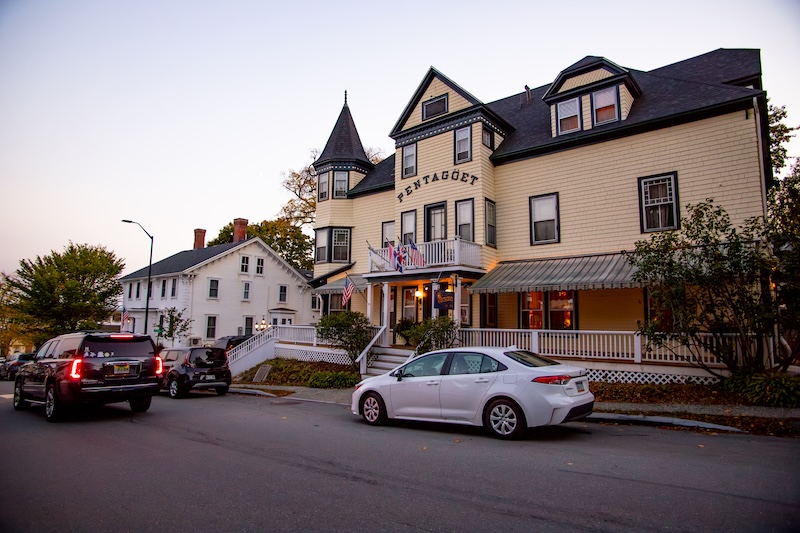
That meeting, on Oct. 9, 1941 in the Pentagöet Inn, took place in Castine, a village at the tip of a peninsula jutting into Penobscot Bay. Ironically, the town had been the site of the nation’s most devastating naval loss some 150 years earlier. And just two months after that 1941 meeting, that 18th century debacle—the infamous Penobscot Expedition—would be eclipsed by an attack on a naval base at Pearl Harbor.
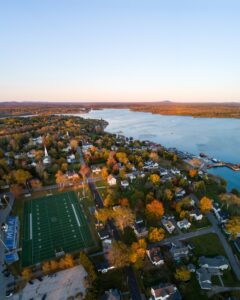
To a visitor today, Castine is as picturesque and peaceful as one could imagine. The tree-lined streets—including elms that survived the disease that eradicated them elsewhere in Maine—feature grand, well-kept 19th century homes.
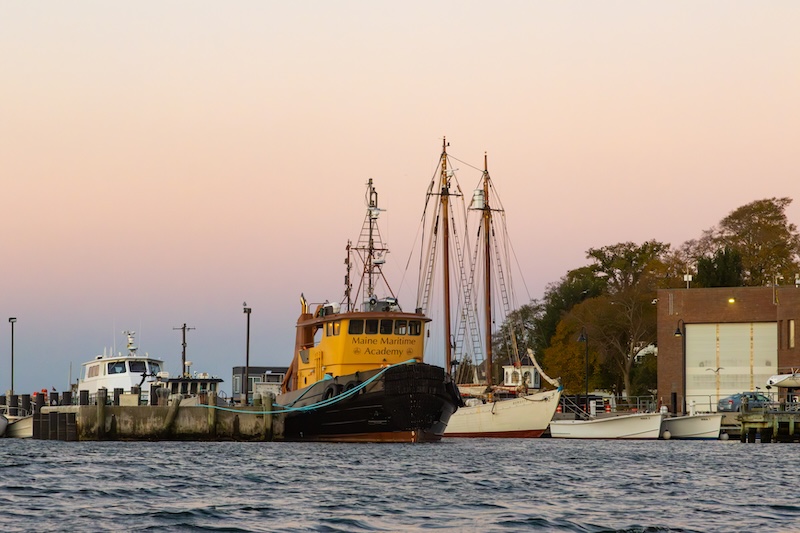
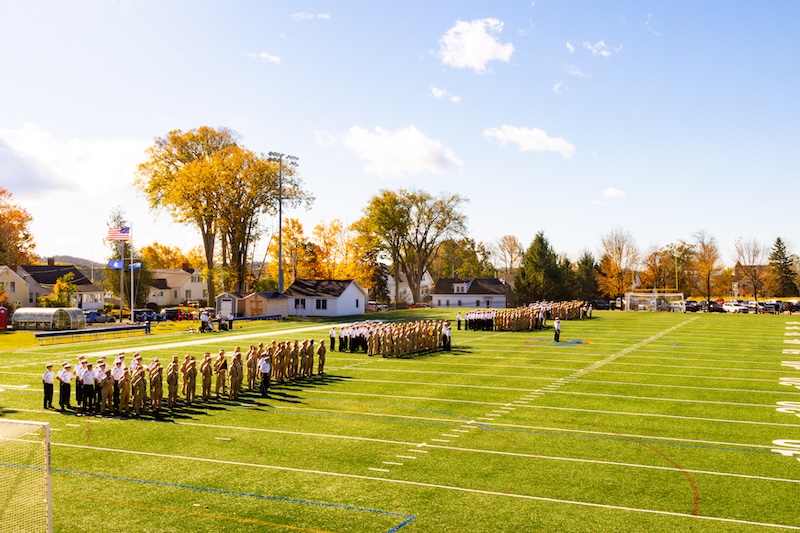
The other dominant feature is the college campus that sprawls across the heart of the town—Maine Maritime Academy, which trained those merchant mariners who helped supply Allied forces during World War II. Today, its graduates land jobs operating sophisticated systems, both on land and aboard ships.
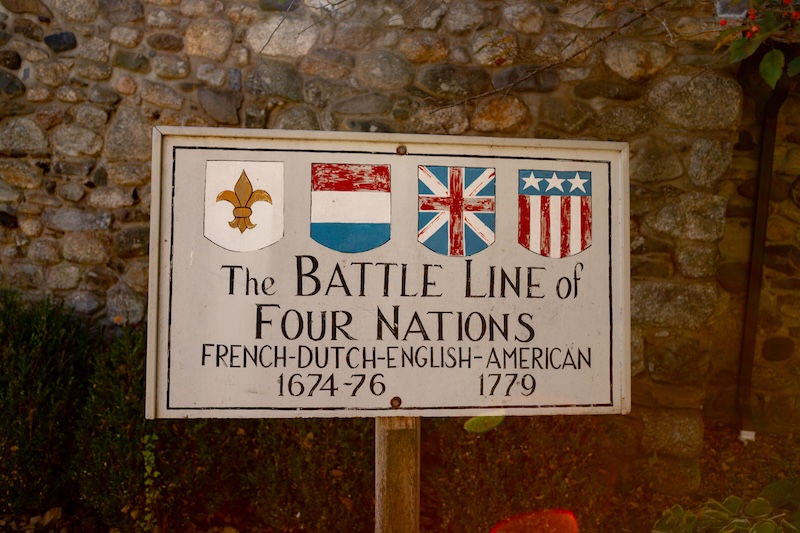
Yet for all its college-town gentility, this narrow peninsula headland—very nearly an island—has been fought over for its strategic geographic location by the French, Dutch, British, and Americans. Signs are placed along the streets at the locations of various forts, battles, and burial grounds. One even notes the site where a Native person cut off the ear of a local man and made him eat it.
If there are any tensions to be found today in Castine—named for the Baron Jean Vincent de St. Castin, a French aristocrat—they lie in the differences in expectations of residents.
From September through May, students and staff at the Academy are visible around town, though hardly a dominant feature on sidewalks and streets away from the campus. In winter, many homes have large thermometers hanging in their windows, making it easy for a caretaker to drive by to see if the furnace is still working. When those residents return, it is often for the warm months only, after students have departed for summer break.
This shared, but alternating use of the town may seem to create a kind of segregated community culture. But those who are working to keep Castine vibrant say these diverse elements make it a dynamic place to live.
Lisa Simpson Lutts, who earlier this year retired as director of the Castine Historical Society, has spent a career in museum and historical interpretation work, and she says the community embraces its rich past like no other she’s seen.
The historical society is housed in the former Abbott School, which it acquired in 1995. The building sits on a town square that also includes a church built in 1790, the library, and the Adams School, built in 1853. That school serves some 50 students in grades K-8.
Lutts jokes that tourists sometimes walk down the middle of the street, “like it’s Colonial Williamsburg,” rather than a real, functioning community. But to be fair, the town square is so authentically old and well-maintained, that it does look like a replica.
Castine’s history has been a draw for tourists since the 1880s, Lutts says, and that led to an unfortunate bit of mythmaking. Signs were erected claiming the town was settled before the Plymouth colony, which simply is not true.
There was a trading post in the area that was connected to the Plymouth colony, but it was not a permanent settlement, and the timing was about 1628, when the region was part of French Canada.
In the 1630s, the French did build Fort Pentagöet, which was the name they used to describe what is now known as the Penobscot River. No remnant of that fort remains; today, a small Catholic chapel stands at the waterfront site. That fort was destroyed by the Dutch, who bombarded it from the mouth of the Bagaduce River in the mid-1670s, marking their brief hold on the peninsula.
The town’s French connection often is honored on July 14, Bastille Day. In his time in the region, the Baron de St. Castin married the daughter of a prominent Native leader, though this union did not spare the indigenous people from European subjugation.
The English maintained control of Castine for the next 100 years, but during the American War of Independence, the ill-fated effort known as the Penobscot Expedition had ships sail from Boston to attack and displace the British hold on the region. The British had built Fort George on the highest point on the headland, whose earthen walls remain visible today.
The historical society cites “poor coordination, bickering commanders, inadequate training, and inexplicable delay” as leading to the disastrous failure of the assault, which resulted in the American fleet scuttling many of its ships in retreat.
More than ships were lost, though. A field at the south end of town is void of buildings because the remains of fallen Americans are buried there, without markers.
After the colonists prevailed in the war, the border with British Canada was established at the St. Croix River, resulting in some Loyalist Castine residents shipping their houses to St. Andrews, New Brunswick.
Trouble with the Brits wasn’t over just yet, though. During the conflict of 1812, British forces occupied the town, and on Sept. 1, 1814, issued this proclamation:
“Remain quietly in your homes, pursue your usual occupations, surrender your arms and do not attempt to communicate with the American forces—and you will enjoy the safety and protection of the British occupying forces.”
The historical society notes that British authorities collected customs duties, and when they left, took the funds with them. They also dug a canal across the narrow part of the peninsula, allowing the quick movement of forces by water, which is still visible, though not passable.
~ ~ ~
That delineation remains, though it is metaphoric. Lutts says for at least a century, the expression “living off-neck, or on-neck” has been used to distinguish those whose homes are in the village that lies on the high headland at the end of the peninsula. Lutts lives in nearby Penobscot. Mobile homes can be found within the “off neck” parts of Castine.
As is the case with many coastal communities, Lutt says, post-pandemic, “There are now more people living here year-round.”
Donald Small’s personal history with Castine rivals in depth the stories of occupying forces.

“My family lived here in the 1920s,” he says during a conversation at the Witherle Memorial Library, built on the town common in 1913. He gestures to a 19th century house across Court Street, where he grew up.
His parents had left, and then returned when Small, now 87, was in second grade. His father taught at the Academy from 1946 to 1960. Small stayed in town through graduation in 1956 from Castine High School—where the historical society is today—until he graduated from college.
After a career working as a contractor for the Navy and then with Corning Glass in North Carolina and elsewhere, he returned as an instructor at the maritime academy where he taught for 30 years.
“The Academy has always been a part of the town; in the early years, more so than now,” he says. Up through the 1970s, most of the faculty and staff lived in town, but “students have always been part of our town.”
Today, Academy students make up half of the town’s volunteer fire department. Small explains that many need the training for their shipboard lives, but they are civic minded in getting involved locally. Academy student volunteers also read to elementary school children.
There are regular “town-gown” confabs, he says. “It’s a reasonably good relationship.”
Fifteen years ago, the town objected to the Academy purchasing a house outside the zone set aside for the college and using it as the president’s residence. The conflict went to court, but folks in town say that sort of disagreement is old news.
One recent bone of contention is the Academy’s decision to extend the pier at which the new State of Maine training vessel will berth. Some folks in town object to the way it will interfere with recreational boating in the harbor. But Small and others shrug off this disagreement and suggest it will pass.
There are about 1,000 year-round residents, he estimates, and with the student body of about 850, plus faculty and staff, a kind of equilibrium is achieved.
Still, the town has evolved in substantive ways over his years here, Small says, becoming less self-contained.
In 1950, there were three grocery stores in town. “By 1970, there was one.” Both a Ford and a Chevrolet dealership were still operating in town through the early ‘70s, he says.
“Even into the 1970s there were carpenters and plumbers and car mechanics in town.” In the house next to his childhood home lived a man who mowed lawns at the Academy, had a trap line, and, it was understood—Small said with a chuckle—“ate venison all year.”
With real estate prices on the neck typically in the $400,000-plus range, that seems unlikely today.
Small has written a book about Castine, set circa 1950—Salt Water Town, published by Penobscot Books, a collection of short stories, some personal anecdotes, some fictional, all very readable and evocative of the era. He also has been active with both the historical society and the Wilson Museum.
But Castine has also drawn those from the upper-middle class for summer stays, including the poet Philip Booth.
“His family had been in town for years,” with his father’s side having roots, Small says. “He was a very easy guy to get to know.”
There are other famous former residents. The 1950s and 1960s, Lutts notes, “was a high point of literary culture,” with Mary McCarthy, author of The Group, poet Robert Lowell, and sculptor Clark Fitzgerald, along with Booth.
Noah Brooks, who was going to serve as President Abraham Lincoln’s secretary in his second term, grew up on the town common, she adds, and became a children’s author.
~ ~ ~
Tourism has always been a part of Castine, Small says, but it took the form of people spending June through August in houses they owned. The Castine Inn and Pentagöet Inn also are long-serving tourism lodging establishments, with a peak coming during the period when Boston steamships called at the landing.
At the Pentagöet, proprietors Matt Powell and George Trinovitch have invested in making the town a destination for tourists. But significantly, they also have worked to develop substantive and meaningful ties with the community, an approach that earned them Innkeepers of the Year honors from Hospitality Maine in 2023.
The partners have hosted events for the community on Halloween and Christmas and served free ice cream to children in town on hot summer days.
Both men have worked with the Castine Merchants Association.
“Not only have we increased member meetings and communications,” Powell notes, “but we’ve heightened the role of the association by overseeing new types of community programming, better collaboration for major holiday events, and increased marketing for the town at large. It makes it feel as if businesses in town are working toward a common goal,” he says.
Powell points out that in April, USA Today named Castine “Best Small Town in the Northeast,” an acknowledgement, he believes, of community efforts.
And on their arrival, the couple has been welcomed. “The overwhelming response has been one of joy and excitement,” he says. “Joy that we’ve re-enlivened a storied community hub and excitement to see what we’ve got up our sleeves next.” The men, both in their 30s, say they have found a group of young professionals in the community.
Summer folk, says Small, have always been an active part of the community and got involved in the golf, tennis, and yacht clubs, which today are under a single umbrella.
“I can take you up to the cemetery and show you the summer people who chose Castine as their final resting place,” he adds.
Today, many of those who own seasonal houses rent them to students.
“I have mixed feelings about it,” Small says, with the short-term nature of the rents possibly working against community vitality. The students, he agrees, are mostly respectful of the town, perhaps because of the career-oriented education they receive.
“Right now, the students are looking at starting salaries of $150,000,” he says, which may keep them focused on their classes, along with the strict Coast Guard certifications many must earn.
All in all, Castine “does seem healthy,” Small says, especially with an influx of those working remotely.
Roberta Boczkiewicz is a recent transplant. She and her husband purchased a home in town in 2013, but didn’t move into it until 2020. They had been living in Milwaukee.
The couple decided to hike the Appalachian Trail, starting at its northern terminus, Mt. Katahdin. “We just fell in love” with the state, she says, and began looking for a house. Castine became home.
“The incredible beauty of the landscape,” she says by way of explanation. “The river, the bay, the ruggedness… just a feeling that it was a special kind of community.” The quietness of the town won them over early on, Boczkiewicz says, but “the incredible array of people here” sealed the deal.
She has given back to her adopted community, running for and winning a seat on the Castine Select Board, only the second woman to serve. The first woman on the board served in the 1950s. Today, Boczkiewicz is joined on the board by another woman.
She and her husband launched a small business in town, the Castine Touring Company which provides narrated excursions around town in two golf carts, dubbed Scarlett and Sally, explaining the rich history.
Though a relative newcomer, Boczkiewicz echoes what others say about the Academy: “It’s part of the town, but it’s also its own entity.” The school “has done a phenomenal job of opening themselves up to us,” she continues, allowing residents to play pickle ball in the field house and swim in the pool.
An initiative that waned during the pandemic, recently revived, has residents “adopting” Academy students, inviting them to Sunday dinner, providing a quiet room in which to study, or, as one resident has done, inviting the student to attend performances of the Bangor symphony and the opera in Ellsworth.
Emerson Hall, which houses town offices, hosts a potluck and a movie every other Tuesday night, Boczkiewicz says, with eight to ten students attending.
“They’re really delightful,” she says of the young men and women.
As a town official, she worries about the new, longer pier. “It poses a bit of a navigational issue.” But the plan “gave us a nudge,” she adds, prompting town officials to develop a harbor improvement plan, now in the works.
The smaller American Cruise Line ships stopped calling on Castine, she said, and there is talk about courting such ships again. So is adding slips to the landing area.
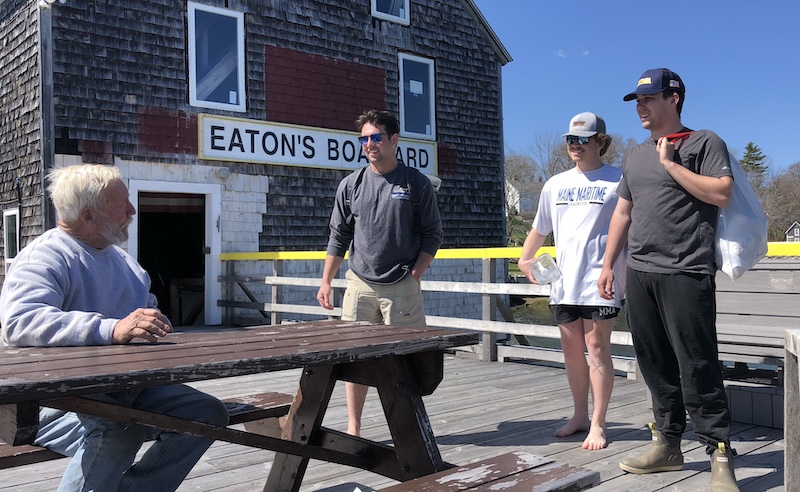
There’s a sign in a window at Eaton’s Boatyard that serves as a resumé for its owner: “Ken Eaton: Native, No Nonsense, Hard Working, Successful, Sincere, Capable.” Chat with the 80-year-old Eaton, whose family took over the yard in 1927, and those superlatives ring true pretty quickly.
Sitting at a picnic table on his pier, rebuilt after the 2024 storms, Eaton talks about his family history here. His grandfather Mace Eaton “came up from Deer Isle in two dories for a job and never left.” Mace bought the property in 1931; the building dates back to 1860.
Ken’s father built boats here from 1945 to 1980, and his grandfather designed the Castine Class 18-foot sloop. These days, Eaton does all sorts of maritime work, mostly related to recreational boats: hauling, storing, setting moorings. He also sells lobster dinners to visitors docking their 100-foot yachts, he says.
Gesturing the houses visible to the north on Water Street, Eaton says, “They used to all be working families,” but now are summer places. Like others, he gives the Academy praise as a community partner.
“They’re just absolutely great,” he says. A few minutes later, three students climb onto the pier from a float, and one young, who has worked for Eaton, chats with him, a comfortable rapport evident.
Eaton isn’t sure what his future holds, and he worries about the growing cost of property taxes, but he takes comfort in town zoning that will preserve working waterfront uses at his yard.
Nina Desmond has lived in Castine—off-neck—for 22 years.
“It used to be a more vibrant down, more stuff going on,” she says, sitting in the small shack from which she operates the town’s recycling and trash transfer station. For 17 years, she had worked at the Castine Inn.
“There’s fewer stores. It seems like there’s more people here but less stuff,” she continues. “Everything’s being more modernized.”
Desmond’s husband works at the Academy on its waterfront. “It’s a more softer Academy,” she says.
And yes, the high cost of houses keeps her off-neck.
“You can’t live in town,” she says, and notes that her daughter pays a hefty $400 per month rental fee for her mobile home.
~ ~ ~
So much of the town’s life seems to relate to Maine Maritime Academy like spokes on a wheel. Kate Noel, who works in the college’s communications office, acknowledges the special connection.
“We see ourselves as partners with the town,” she says, with the success of both the Academy and the town mutually dependent. “Our students really understand the importance of maintaining relationships in a small community. And the town understands the quality of our students.”
Of the 850 full-time students, about 600 live in the dormitory. About 55% of students choose the “regimental” program, which has them wearing uniforms, drilling, and adhering to other disciplines. This track is required for students seeking the Coast Guard unlimited class license, Noel says. Other students may be in the small vessel program, which allows them to work on tugs and barges.
Some 90% of students are employed within 90 days of graduation.
“It’s the best of purpose-driven education,” she says, ideal for those “who love the water, want the promise of a career through practical learning, and are passionate about what they do.”
Desmond at the recycling center offers a blunt summary of Castine today: “It’s a nice town. It’s quiet. If you want quiet. If you want controversy, we’ve got that, too. You hear everything at the dump.”