PHOTOS BY JACK SULLIVAN
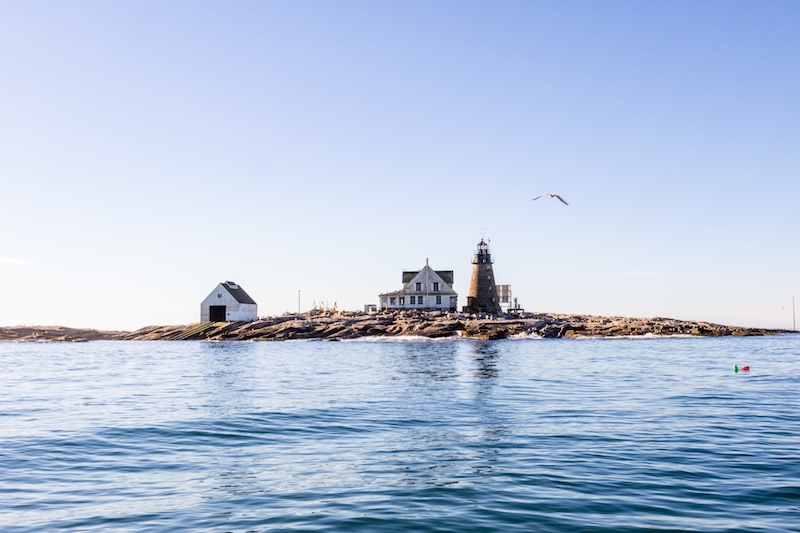
You would think Mount Desert Rock, a 3-acre chunk of granite some 25 nautical miles off Mount Desert Island, would be barren, but the island is teeming with life, bursting with stories. You just have to know where to look.
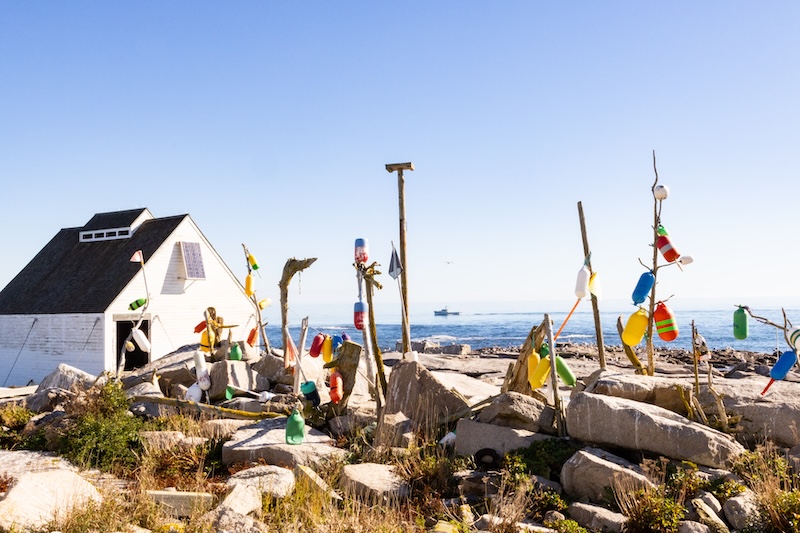
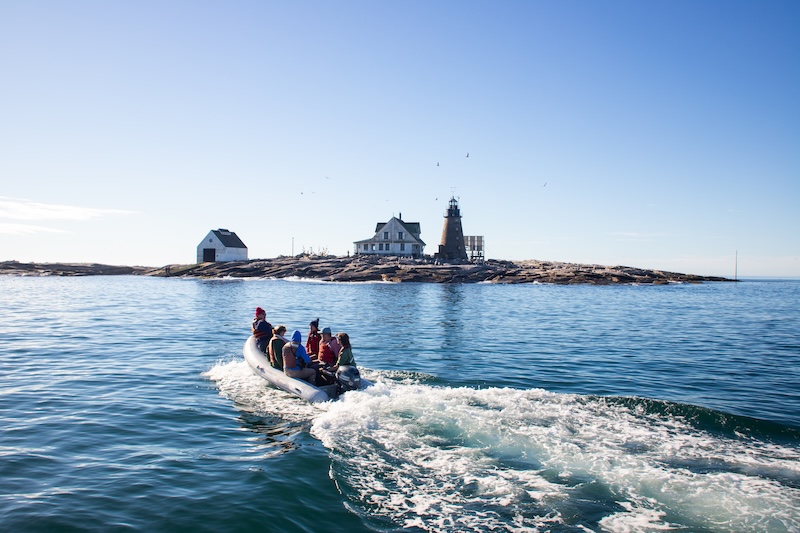
Coming from an inland eye, Mount Desert Rock isn’t much to look at. A cluster of buildings on a rocky landscape standing 15 feet above sea level at its highest point. There are no trees save for the driftwood limbs erected east of the old keeper’s house. The island’s largest plant, a sprawling beach rose bush, a species invasive to Maine, juts up from the granite south of the house, spawning flies and sheltering songbirds.
Mount Desert Rock was given its name by French navigator and cartographer Samuel de Champlain in 1604. Few mentions of the Rock exist before the early 1800s. As shipping and travel increased between Boston and the Bay of Fundy, the Rock itself posed a threat to mariners. Multiple ships have wrecked upon its shores, and following the well-known wreck of the brig Billow out of Boston, mariners called for Congress to construct a lighthouse. Their plea was met with support and $5,000—equivalent to over $171,000 today—for the light’s construction.
In 1830, the United States Lighthouse Service built that first lighthouse—a stone dwelling topped with a wooden tower. On Aug. 25, the light began operating under the care of Esaias Preble, the first head keeper, with his son William serving as assistant keeper. Like many lighthouse stations at the time, the Rock was a family station. The keepers’ wives and children would live with them, even on such an isolated site.
After only a year of operation, a government official reported that conditions there were grim, with both the tower and attached dwelling close to falling apart due to shoddy construction. In response, a second lighthouse, a 58-foot granite tower, was built from rocks from the island in 1847.
In 1939, as the world descended into World War II, the lighthouse service was transferred to the Coast Guard, ending the age of family light stations and ushering in a new era where coast guardsmen kept the lights. Often, these coast guardsmen were in their early 20s and hailed from inland states. Adjusting to life on the Rock proved to be a challenge for many, so much so that the Coast Guard flew a pool table by helicopter to provide entertainment for the men stationed there.
Marine life and visitors also provided some respite from the island’s isolation. The waters around the Rock experience upwelling, a process by which cold, nutrient-rich water is pushed up from the ocean’s bottom. This movement of nutrients attracts an abundance of marine life, including large species like whales, dolphins, sharks, sea turtles, and fish like ocean sunfish and tuna. And these animals, whales, and other marine mammals attracted the attention of College of the Atlantic.
The college’s marine mammal laboratory Allied Whale was founded in 1972 by faculty, staff, and students. They arranged with the Coast Guard for students to stay at the Rock that summer, four students total, two at a time. The island offered the unique opportunity to observe whales from the lighthouse, a vantage point that was a part of the natural environment. Unlike being on a research vessel, a couple of researchers with binoculars up in the tower didn’t impact the whales and their behavior.
In 1988, COA student Tim Cole shared a glimpse of life on the Rock with the Christian Science Monitor: “I like to get up into the tower maybe a half-hour before sunrise. As the sky lightens, things gradually start to happen. More birds fly by, or a few whales become visible. You can sit and watch as the world starts to move.”
In 1977, the Coast Guard automated the light at Mount Desert Rock, ending over a century of manned operations. Right before Christmas the final two keepers returned to the mainland by helicopter. One of the men—Douglas Nute, a 22-year-old coast guardsman from Missouri—was more than ready to escape. Nute had been stationed at Great Duck Island prior to his tenure at the Rock and, when comparing the two, he said:
“At least on Great Duck, you had a mile and a half circumference you could walk, and trees, and grass, and birds, and people over on the other side you could talk to. But on this Rock, there was nothing but the noise of the foghorn day and night.”
After automation, College of the Atlantic leased the Rock, continuing whale research under the charge of Allied Whale. The research had switched from stationary observation from the tower to more mobile means, using Zodiac inflatables to get up close once a whale was sighted from the tower. Binoculars were used in tandem with film cameras, and the resulting images were used in developing photo-identification techniques for humpback and finback whales.
For a short period in the late 1980s and early 1990s, the Rock was left uninhabited as research focuses shifted. Through the Maine Lights Program, an effort conceived and initiated by Peter Ralston, co-founder of Island Institute, Mount Desert Rock Light and neighboring Great Duck Island Light were officially transferred to College of the Atlantic in 1998. Initial trips out to the Rock revealed that American herring and great black-backed gulls had turned the island into a nesting colony in the absence of humans (and their canine counterparts).
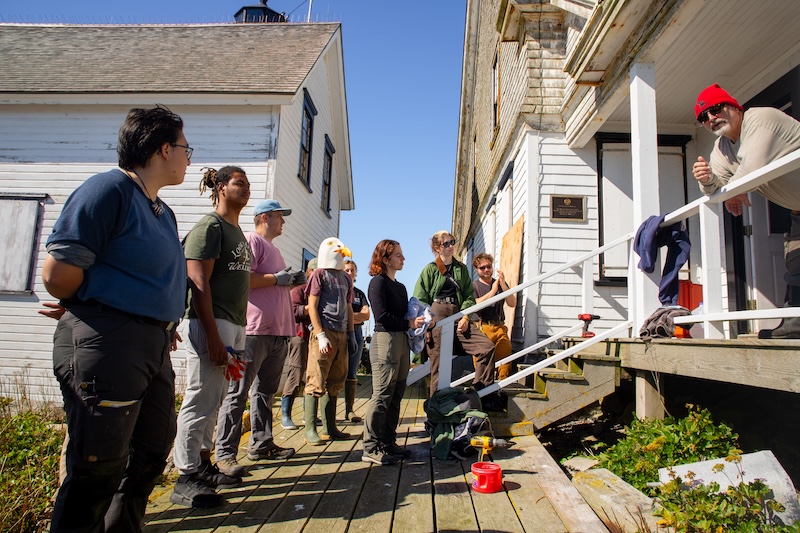
In this incarnation of the Rock, the station’s research expanded from a heavy focus on whales to include seals, sharks, fish, birds, plankton, invertebrates, seaweed, terrestrial plants, microplastics, currents, and other aspects of physical oceanography. Writers, artists, historians, philosophers, and other creatives also found their way out, where they could explore their ideas far from the distractions of the mainland.
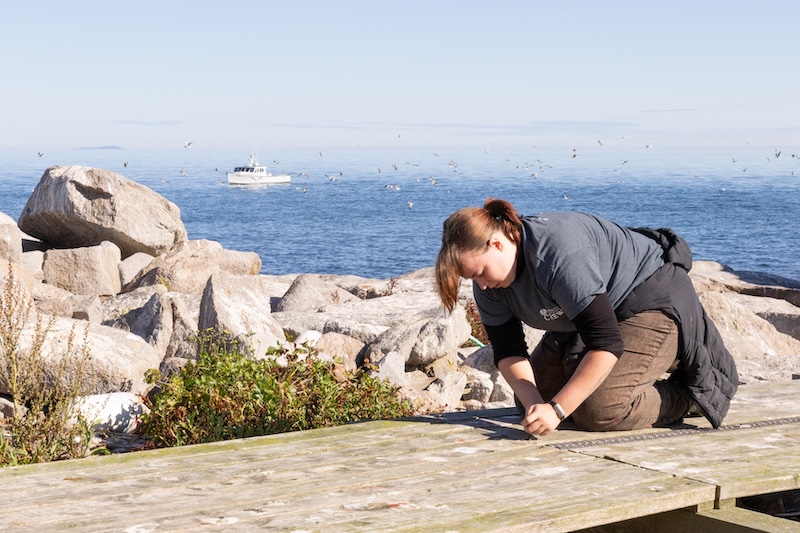
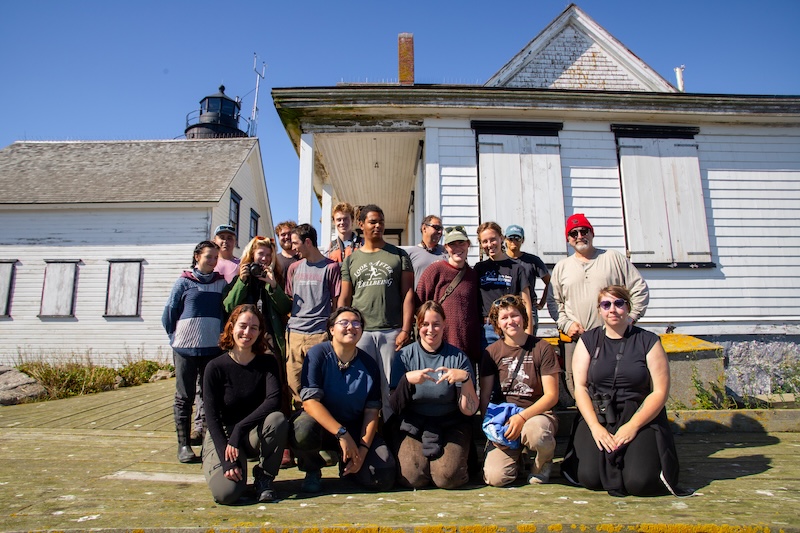
As a student at College of the Atlantic, I was lucky to spend three summers on the Rock as an artist, researcher, writer, and station manager. Life on the Rock definitely took some getting used to. We had little to no privacy, operated at the mercy of the fog and weather, and had to make our own fun with what we had at our disposal. Sometimes this fun manifested as jam sessions in the lighthouse basement with a homemade didgeridoo or walks along the intertidal looking for treasures—trash and bones.
Weekly supply runs brought groceries in fish totes, jugs of fresh water, and mail from the mainland and our friends on Great Duck Island. Toting 40-pound jugs of water up the slippery boat ramp to the house was not my favorite part of island life, but it couldn’t be avoided. With no local source of fresh water, we were dependent on our weekly delivery of water for drinking, washing dishes, and showering. Showers were a weekly occurrence unless you felt inclined to take an ocean bath.
My mentor and the station’s facilitator, Dan DenDanto, quips that the Rock is “where things go to die.” I like to think its where things go to live, me included. Sometimes dying (or coming close to it) is just part of the equation. On the island something seemed to die every other day; living in the middle of active gull and seal colonies, it was to be expected.
We witnessed gulls go from egg to speckled chick to awkward fledgling over the course of three months. Some moments were beautiful. Gull eggs hatching and being doted on by their parents, gull chicks growing into their feathers, and fledglings finding the right combination of movements to take flight for the first time.
Some moments were hard to watch. Inexperienced gulls built their nests too close to the intertidal, adult gulls stole chicks from other nests to feed to their own young, and fledglings learned to take flight only to break their wings while trying to land. For every gull that made it to the end of the summer, there would be a few that didn’t, their remains rotting in place unless moved by scavengers or waves.
The more time I spent on the Rock, the more I started to wonder just how long it will exist as the place I have come to know and love. The more life I saw and the more nothing seemed certain or promised, the more I accepted the temporary nature of this place and its cycles.
I don’t know how much longer there will be a research station on the Rock. I don’t know how much longer there will be a lighthouse on the Rock. I don’t know how much longer the gulls will nest and the seals will lounge on the ledges. But I’m certain that time will keep passing and life will keep moving and the Rock will be there.
Regardless of whether people forget its stories or keep them alive, whether people can see it or the sea swallows it whole, Mount Desert Rock will still be there, keeping watch.
Olivia Jolley graduated from College of the Atlantic in Bar Harbor in 20—and served as an Island Institute Fellow from 2021-2022 on Swan’s Island.