While living with Gary Snyder in the Sierra Nevada Mountains in the mid-1970s, Gary Lawless remembers the celebrated poet and the people around him becoming excited about the idea of watershed politics and bio regionalism “and trying to figure out how best to live in a place while doing the least harm to the whole ecosystem.”
To do that, one needed to learn about everything, in “a process that never ends.” The idea, Lawless explains, was that the more you learned from those other systems, the better you could live there “in support rather than in defiance.” The Gulf of Maine Bookstore he and his wife Beth Leonard launched in Brunswick in 1979 grew out of this concept, honoring that vast body of water that stretches from Canada to Massachusetts.
The Whole Earth Catalogue started pushing the idea of rewilding as did a lot of writers at the time. “You start realizing the harm that’s been done to other species,” Lawless relates. He welcomes the process of trying to encourage and enhance other species, “even if you’re just planting some milkweed for butterflies.”
He points to folks in Portland who are replanting eelgrass beds. He also salutes those removing dams and fighting invasive species—the worst of which, he points out, are humans.
Lawless lends his voice and poetry to a number of causes in Maine. In October he read his poems at the annual meeting of a group opposing the Nordic Aquafarms salmon project in Belfast. “They did it like a church service,” he recalls, with his poems about “ecological integrity and spirit” taking the place of hymns between various reports. The group’s efforts paid off: Nordic Aquafarms abandoned its plans this past February.
Growing up in Belfast, Lawless knew first-hand the environmental impact of industry. Two poultry plants and a sardine factory fouled the harbor. Indeed, when he shared the question, “Do you remember your first island?,” with his cousin Jimmy, this childhood companion replied, “The first island we saw was the island of chicken guts in the bay.”
Because of the pollution and the smell, no one swam in the harbor and there were few pleasure boats because “they would’ve gone to hell right away.” Without water treatment the effluent went directly into the water, which, Lawless adds, “made the fishing great: the mackerel, the stripers—there were a lot of fish in there and bottom feeders and seagulls.”
As a youngster, Lawless recalls camping out on Sears Island with the Boy Scouts year round. He liked the feeling of being removed from the world while on the island. It was a special place.
And it remains so to Lawless, who has been fighting the plan to develop a port for floating offshore wind fabrication, assembly, and deployment. The idea angers him as there is a site across the way on Mack Point that could serve this purpose. “That’s what kills me,” he says: “It’s all set up!”
In his lifetime, this is Lawless’s fourth Sears Island skirmish. Proposals ranged from an aluminum smelter and oil refinery to a nuclear power plant and liquefied natural gas port. When Gov. Angus King proposed a container port, Lawless sent a poem about eelgrass to his office every day for several weeks. When the project fell through, King blamed the eelgrass.
Lawless remains on the side of eelgrass.
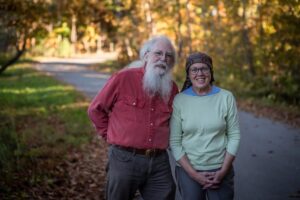
“Why not save and protect eelgrass instead of lamenting its loss?” he asks. He points to studies by the Friends of Casco Bay showing the serious depletion of this important nursery for sea creatures. He also notes the importance of Sears Island to the Penobscot and Passamaquoddy tribes who made a pilgrimage trip there last year.
Lawless became immersed in contemporary poetry as a student at Colby College in the early 1970s—a tumultuous time with civil rights and the Vietnam War protests in full swing. He discovered the Bern Porter Collection, a wondrous assortment of avant-garde writers established by the writer, poet, and self-proclaimed “draftee into The Manhattan Project”—and graduate of Colby’s class of ’35.
Lawless already knew Porter. As a teenager in Belfast, he and his friends had been warned not to hang around “the local eccentric,” so of course they did. He remembers Porter telling him that the two people in Maine he should know about were visionary architect Buckminster Fuller and psychoanalyst Wilhelm Reich. He subsequently heard Fuller speak in Camden and visited the Reich Museum in Rangeley.
At Colby, Lawless dove into contemporary poetry while majoring in Japanese studies. He discovered Theodore Enslin who lived in Temple (and later Milbridge) and the aforementioned Gary Snyder. He started a student group and got funding to bring them and other poets to the college.
During Snyder’s visit, Lawless told him that after college he’d rather move to the West Coast and be his apprentice than go to graduate school. The older poet told him to come along if he still felt that way when he graduated—and he did, moving directly from Waterville to the foothills of the Sierra Nevada Mountains in 1973. Through Snyder he met many famous writers as well as such political activists as Jerry Brown and Daniel Ellsberg.
Lawless also recalls bringing back-to-the-land gurus Helen and Scott Nearing to Colby to give talks. The couple brought their own wooden bowls, forks, and knives and refused to eat the institutional food—“We’d have to get them some vegetables,” he recalls, adding, “It was always an interesting visit.”
Later, Lawless was on Helen Nearing’s book committee along with musicians Gordon Bok and Paul Winter. They were tasked with stewarding the library, which suffered from humidity (they eventually raised the money to send the books to the University of Maine for cleaning).
“It was great because you got to see what the Nearings were reading,” he recalls. “They had a whole shelf of UFO books.”
Not long after opening the Gulf of Maine Bookstore, Lawless and Leonard befriended writer Kate Barnes who was a regular customer. In 1987 the future first poet laureate of Maine asked the booksellers if they might consider taking over the stewardship of the family home, Chimney Farm, in Nobleboro. They agreed and have lived there ever since.
Overlooking Damariscotta Lake, the cozy abode, placed on the National Register of Historic Places in 2007, was once home to Barnes’s parents, poet, essayist, and award-winning children’s book author Elizabeth Coatsworth and Henry Beston, among the most celebrated naturalist writers of the last century.
The Chimney Farm homestead gets its name from the house’s five chimneys. Today, wood stoves hook up to three of them, warming the kitchen, dining room, and parlor.
When Coatsworth and Beston lived there, there was no electricity or plumbing. Today, an array of solar panels stands nearby.
In the beginning the pair took care of Barnes’s horses, seven at the time. She gradually sold them off, mostly to Amish farmers because they favored the breed she had.
Eventually, Barnes was down to one horse, a driver that pulled her sleigh and carriage. The horse seemed lonely so Lawless and Leonard adopted two donkeys to keep it company. These three hoofed creatures eventually passed on, but the couple never lost their love of domesticated equines. Today, they care for two donkeys, Clementine and Mavis, which they found at Save Your Ass Long Ear Rescue in New Hampshire.
Lawless and Leonard also serve as caretakers of literary materials found at Chimney Farm, much of it now housed in the Maine Women Writers Collection at the University of New England in Portland. Among the treasures they discovered was a packet of letters with photographs sent to Coatsworth and Beston by Silent Spring author Rachel Carson.
Lawless notes that they are not yet done sorting papers. “Kate always said the farm’s major crop was words,” he once noted.
Aside from Boy Scout trips to Sears Island, Lawless only occasionally visited the Penobscot Bay archipelago. A friend’s father, a tugboat captain, invited him once to meet the Maine Maritime Academy’s ship returning from its world cruise. They towed it into Castine, which was great fun.
Later boat trips involved the artist Bryce Muir (1946-2005), who would on occasion invite Lawless to sail on Merrymeeting Bay. A renowned toymaker and wood sculptor who also made fanciful lawn ornaments (among them, a life-size replica of Andrew Wyeth’s Christina), Muir would gather a group of friends for a day of “yarting”—yacht art-making—on the bay aboard Toad, which he had built himself.
Anchored off one of the many islands—Bonsai, Eagle, Brick, Sturgeon, etc.—guests would paint and draw while Muir played the flute or poets read. Members of that group of “yartists,” which included Pam Burr Smith, Carlo Pittore, Natasha Mayers, Katherine Bradford, and Stephen Petroff, became the founders of the Union of Maine Visual Artists. The website Brycemuir.com includes a section devoted to these voyages.
For three summers, the Gulf of Maine Bookstore sponsored a boat excursion to Ragged Island off Harpswell, the former home of the poet Edna St. Vincent Millay and her husband, Eugen Boissevain. Led by Ramona Barth, a Millay aficionado, the boat circled the privately owned island while an actress recited her poetry. In the poet’s day they would have found a sign on the island stating that bathing suits were not allowed—and, Lawless notes with a laugh, lobstermen hauling traps close by.
He has taken part in the annual Millay birthday readings at the Farnsworth Museum and given talks on her life on Ragged Island. You can hear him read her poem “Conscientious Objector” on the Friends of Millay House Facebook page.
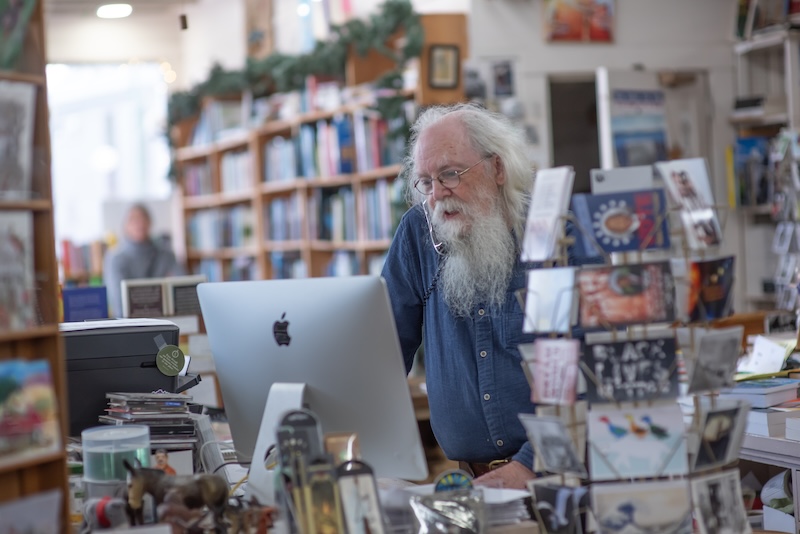
As veterans of the book business—they’ve run their independent bookstore for 46 years now—Lawless and Leonard have finessed an approach to selling books that includes getting to know what their customers are interested in and engaging them in conversation. “And if they keep coming back,” Lawless explains, “you build on that.”
Chimney Farm (June, 1987)
There is an empty stall in the barn where Ironside Jack the
stallion lived. Last week two Amish farmers and their driver
came and took him to Pennsylvania along with Sally the mare.
From Jack’s stall in the barn you see the farmhouse:
weathered, red, and surrounded by flowers. Beyond the house
you look east over the horse pasture and down to the lake.
There are vegetables and wild lupine off to your right, and the
place where the town road ends. Near dusk the horses walk
to the fence gate, hoping for grain. These horses haul our
winter wood, turn the earth for our gardens. They give us
warmth and life. Jack was like the guardian spirit of the place,
always watching everything from here in his stall. Across the
lake, cottage windows reflect the setting sun. Birds fill the air
with sound. The light in the kitchen is yellow. Fog moves in
behind the islands and everything starts to quiet. Later the
loons will call from the cove. We will sleep, dreaming of
wind, of rain, horses moving in the barn, and loon song, loon
song pulling us into the dark water. We dive under, dive
under and come up, somewhere else.—Gary Lawless
They’ve witnessed shifts in the book business. Bookland and Borders, the chain bookstores, went bankrupt while Barnes & Noble and Sherman’s held on. They count themselves lucky to be located in the center of a college town. “At first we were the funky weirdo hippie bookstore,” Lawless recalls, “which was fine with us.” While their offerings have expanded, there are still books they won’t carry.
For going on 40 years the couple has sold books each fall at the Common Ground Fair. The first year there were about 500 visitors at the fair over the three days; last year there were 64,000. “We thought maybe the hippies won one,” Lawless says with a grin.
At one point, the bookstore set up a satellite office at Camp Kieve where famed poet Robert Bly hosted a week-long poetry festival every summer for several years.
“We were open for two hours every evening and met these incredible people,” Lawless recollects. He remembers a book signing with Galway Kinnell where the poet requested two facing chairs. “Each person in line sat down and talked to him while he signed a book, so every person felt seen.”
They avoid Facebook, have no website, and only post occasionally on their Instagram account and Gulf of Maine poetry blog. They use their front window to publicize various events or to express their philosophy. “Make America an endless expanse of old-growth forest with no certain borders again” reads one sign, in large all caps. They host readings, on and off-site, including recent talks by printmaker Siri Beckman and a celebration of Franklin Burroughs’ new book, The View from Here: Reflections on the Deep North, the Wild East. Lawless launched Blackberry Books, a small but mighty press, before he got into the bookselling business. Blackberry was the nickname given him by poet Gary Snyder’s five-year-old son, to help differentiate the two Garys.
The idea to publish began when Lawless was working at Bookland with poet James Koller. Koller edited the ground-breaking Coyote’s Journal that published many of the most progressive poets of the day, among them Robert Creeley, Joanne Kyger, Charles Olson, Allen Ginsberg, and Robert Duncan. He taught Lawless the ropes.
Starting off in 1974 with small limited editions of contemporary poets, Lawless eventually turned to Maine writers, including Kate Barnes, Sanford Phippen, Sylvester Pollet, and Leo Connellan.
As postmistress in Cushing for a couple of years, Beth Leonard had met a number of well-known writers, including Elizabeth Ogilvie and Dorothy Simpson. Introduced to Simpson, Lawless ended up reprinting her 1960 book The Maine Islands in Story and Legend.
As a publisher, Lawless is best known for reviving the writings of Ruth Moore, the Gotts Island-born author who lived in Bass Harbor for much of her life. Once referred to as “New England’s only answer to Faulkner,” Moore had slipped into semi-oblivion as her novels went out of print and publishers considered her work to be too regional.
Lawless took her on, reprinting a dozen books over the years until he handed off the titles to Dean Lunt at Islandport Press. As part of his promotion he printed “I Read Ruth Moore” bumper stickers, giving them to customers who bought her books. The Fogler Library at the University of Maine houses the Gary Lawless Collection of printed ephemera pertaining to his publishing company, literary career, and bookstore.
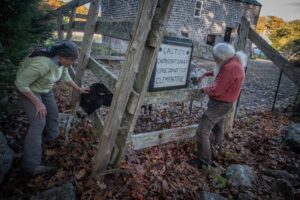
“Moore’s novels preserve a language from a particular time,” Lawless says. Reading her, he can remember his grandmother from Prospect, who “talked like that.” He is proud that today Moore’s books are taught in Maine high schools and colleges.
On each of the five trips he made to Sears Island last summer, Lawless took along Moore books and added them to the little free library. “They’re always gone when I get there,” he reports, “so somebody’s getting them.” He thinks Moore would have gotten a kick out of that.
On a trip to Gotts Island some years ago, Lawless met John and Christina Gillis who spent summers in Moore’s former home. He recalls a somber visit: that day a boat was to arrive bearing the ashes of the couple’s son who had died in a plane crash in Africa. “They were so generous to spend that time with us,” he recalls, “but then maybe it helped take their minds off what had to be a really hard day.”
On another visit to the island Lawless and Leonard joined philanthropist Elizabeth Noyce and a Maine state archeologist on a dig of the shell mound that Moore had started to investigate as an amateur. He laughs remembering he and his wife upside down in a hole with Noyce. Later, the Abbe Museum organized a show of objects from the Ruth Moore shell mound site.
Lawless is also dedicated to the poetry of his friend Nanao Sakaki (1923-2008). He edited and published Sakaki’s collected poems and has been instrumental in having books of his poetry printed in France, Italy and Brazil.
Lawless and Leonard hosted the venerable Japanese poet on many occasions and took him to the World Heavyweight Poetry Championships in Taos, New Mexico.
One May, the couple drove Sakaki to northern Newfoundland to see icebergs. On that trip, which involved winter camping, Caribouddhism was born.
“I suggested that we become caribouddhists, wandering with the great herds, listening to their stories, tasting the ice,” Lawless has written. This new religion inspired his 1998 poetry collection, Caribouddhism.
Lawless has cut back on publishing in recent years, tired of having big boxes of books and paying for a warehouse “and all that.” He notes that a lot of the printers he used are no longer in business. That said, he is thinking of bringing out another edition of Sakaki’s Collected Poems. “I don’t want it to go out of print while I’m alive.”
Over the years Lawless has been writer in residence in several far-from-Maine locations. He has spent a month is Sitka, Alaska and part of a summer in Isle Royale National Park, an island in Lake Superior accessible by a six-hour boat ride. The year he was there, the park counted 2,200 moose, about 34 wolves, and less than 100 people on its 45-mile-long expanse.
Lawless’s most recent residency took him to Venice for a month in 2017, courtesy of the Emily Harvey Foundation.
The residencies, Lawless avers, help get him thinking about new stuff and away from the day-to-day routine. He reads up on the natural history of the place and the poets who lived there. “It furthers my learning, I guess, then I get old and forget it all.”
Such immersion leads to writing, in this case, Lawless’s most recent book of poems, How the Stones Came to Venice (2021). Accompanied by photographs by Leonard, the book offers the poet’s riffs on his Venetian experiences but also his love of quarries, which date back to visiting his grandfather Lester Dow’s store in Prospect, which catered to quarrymen.
In 2017, Lawless received the Maine Humanities Council’s top honor, the Constance H. Carlson Public Humanities Prize, in honor of his work “to bring poetry and the creative process to the people of Maine, his commitment to helping Mainers of every background find their voice, and his ardent devotion to the environment and to all those that inhabit it,” as the citation reads.
Lawless has sought to bring poetry into the lives of underserved populations in Maine, including veterans, the unhoused, the disabled, and the displaced. He has gone to Preble Street in Portland, the Vet center in Lewiston and Bates College to work with Somalis.
For more than 40 years Lawless has been involved with Spindleworks Art Center in Brunswick, which assists individuals with intellectual disabilities to achieve “full and inclusive lives in their chosen communities through the arts.” Last year, he published a memoir by one of the Spindleworks members, the special Olympics medal-winning skier and recent Maine Sports Hall of Fame inductee Anna McDougal from Wiscasset. “She says she doesn’t have Down syndrome,” Lawless notes, “she has Up syndrome.”
Lawless likes going to these communities to do poetry because many of them don’t read or write English. “I keep telling them, poetry has long been an oral art—Homer couldn’t read or write supposedly.” He judged the Mount Ararat Poetry Out Loud competition this year. “We had 13 kids reciting poems and they were all excited about it, which I love seeing,” he reported.
Everything is Holy.
Bless the Lagoon, sweet Saint Lucy,
Bless the birds, the fish,
Bless the trees on the outer islands,
Bless the waves and the wind.
Send the cruise ships to Hell.
There is room there,
for one more boat.
—Gary Lawless, from How the Stones Came to Venice
As bass player for the Leopard Girls, Lawless performs at weddings, Schooner Days, and in the historic jailhouse in Wiscasset where they played jail and prison rock ‘n roll songs. The band also takes part in the Friday night art walks in Brunswick, performing in front of Spindleworks. “We have a street dance, and it’s sponsored by adults with disabilities,” Lawless says.
In their seventies, the Leopard Girls don’t care if they get paid or not. Says Lawless, “We just want to have fun, you know?” You can watch them play “Bony Maronie” on YouTube.
“I keep going back to Penobscot Bay,” Lawless says near the end of the interview. “I mean, that’s really genetically the place I feel linked to.” He also notes with pride the conservation easement he and Leonard set up to preserve the Chimney Farm property. They’ve manage to protect all by 400 feet of the 6,000 feet of shorefront on Damariscotta Lake. “So the loons are happy,” he says.
Lawless carries forth the vision of those former stewards of Chimney Farm, especially Coatsworth. “If Americans are to become really at home in America,” she wrote, “it must be through the devotion of many people to many small, deeply loved places.” These places, she says, must be “sung and painted and praised until each takes on the gentleness of the thing long loved, and becomes an unconscious part of us and we of it.”
You can hear her voice in the exhortations that ended a note about Sears Island that Lawless sent to friends earlier this year: “Go to the island. Walk the paths, the beaches. Experience it for yourself and then fight to save Sears Island.” For the poet, this island is “the thing long loved.”
Carl Little has published several books about art. His latest collection of poems is Blanket of the Night (Deerbrook Editions). He lives on Mount Desert Island.