
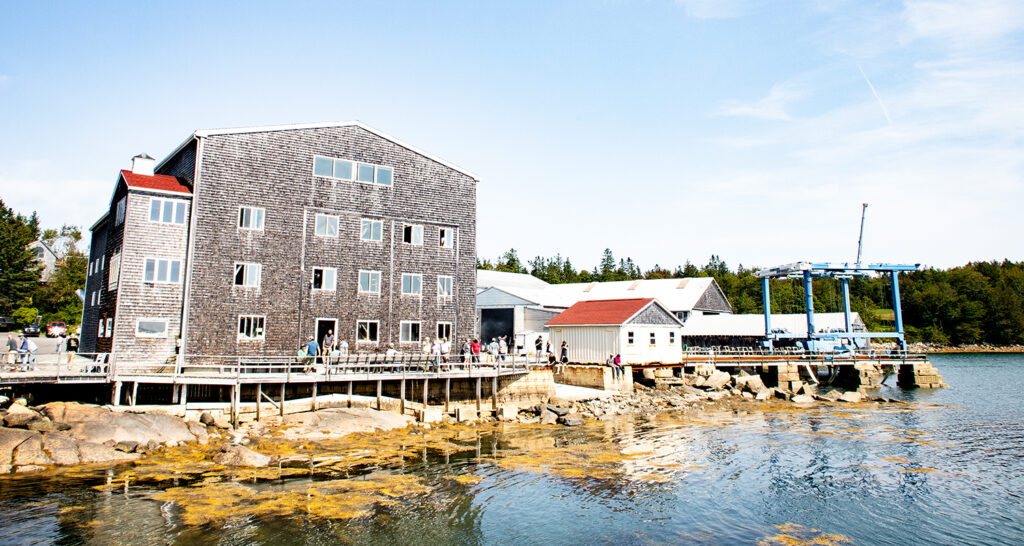
 Brooklin sits at the southern tip of Maine’s Blue Hill Peninsula, surrounded by water on three sides and connected to the mainland by roads that cross saltwater bridges. Home to just over 800 year-round residents, the town’s economy and identity are deeply tied to its working waterfront, with boat building, fishing, and marine services playing a central role in community life. But Brooklin’s coastal geography also creates unique vulnerabilities. Much of the town’s development, including key transportation corridors and electrical infrastructure, is concentrated along the shoreline, where increasingly frequent and severe coastal storms threaten reliable access to power.
The consequences of these prolonged outages ripple throughout the community, affecting residents who depend on medical devices, disrupting businesses and schools, and cutting off essential communications, heat, and water.
Those risks have become more apparent in recent years. Brooklin energy ratepayers experience multiple power outages lasting over 24 hours. The exact number of these outages is difficult to articulate, as local residents believe the number reported by energy providers understates the full extent of service disruptions. The consequences of these prolonged outages ripple throughout the community, affecting residents who depend on medical devices, disrupting businesses and schools, and cutting off essential communications, heat, and water. The town’s volunteer-led climate committee recognized both the urgency of these challenges and the limits of its technical capacity to address them alone. To address these challenges, Brooklin applied for the Energy Technology Innovation Partnership Project (ETIPP), a federally funded technical assistance program.
A community-guided energy planning program
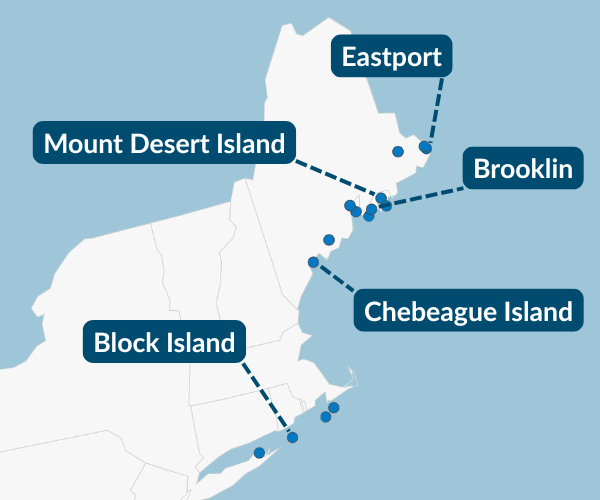
ETIPP partners the national labs’ energy experts with local experts from coastal, island, and remote communities to bolster and develop energy resilience. Communities complete the program with defined goals, research-based pathways to funding opportunities and infrastructure upgrades, and real relationships with their electric utility. ETIPP’s two tracks, Strategic Energy Planning and Technical Deep Dive, also provide up to $50,000 in direct funding to participating communities. The hallmark of ETIPP is that it’s technology agnostic; a community-driven program that meets communities where they’re at. Projects center around goals, not specific technologies. That means that if your community’s priority is resilience and you need an oil backup generator to achieve resilience, that’s what the lab team will analyze. The national labs direct communities to previous completed projects, the most up to date technologies, and costs and trade-off associated with different energy projects.
The hallmark of ETIPP is that it’s technology agnostic; a community-driven program that meets communities where they’re at.
As the Northeast Regional Partner for ETIPP, Island Institute’s resilient energy team has guided 21 island and coastal communities. 65% of the communities who have completed or are currently enrolled in ETIPP are based in Maine. We project manage: convening stakeholders, facilitating meetings, and translating the science and engineering of energy resilience for local needs. We are the voice that explains what a nor’easter really feels like to a scientist based in Berkeley, California. Our team not only leads communities through ETIPP projects but also helps them decide if the program is a fit. Learn more about ETIPP here.
Brooklin’s Journey to energy resilience
Brooklin joined ETIPP in 2024 to better understand its options for improving energy resilience, reducing long-term energy costs, and increasing local renewable energy generation. According to their application: “We are a small rural town with limited municipal staffing and financial capacity. Our volunteer committee drives the town’s pursuit of a resilient grid that integrates more renewable energy. We are aware of our energy challenges yet lack the expertise to solve them.” Working with technical experts from Lawrence Berkeley National Lab and National Lab of the Rockies, the town explored what a more reliable and resilient energy future could look like for its residents.
 A team comprised of volunteers from Brooklin’s Climate Response Committee, Island Institute, and national lab experts evaluated several potential pathways to reach this community-identified goal. Initial analysis examined the feasibility of a community microgrid connecting Brooklin’s school, town hall, and fire station, but found a multi-building microgrid difficult to justify from both a resilience and cost-savings perspective.
The team then assessed stand-alone microgrid opportunities for each facility individually. Through that process, community leaders identified Brooklin’s school as the highest-priority site to invest in energy solutions. As a central gathering place and potential emergency shelter during severe weather events, a more resilient school could provide important support to residents when outages occur. Building on that finding, the ETIPP team conducted a detailed analysis of solar generation and battery storage options for the school, helping the community better understand the costs, benefits, and operational considerations associated with different system designs.
The ETIPP process provided a clearer path forward, grounded in data, community priorities, and a shared vision for a more resilient energy future.
As the project moved toward completion, Brooklin gained more than technical analysis. Community members developed a stronger understanding of the opportunities and constraints associated with local energy projects and gained tools to engage more effectively with utilities, technology providers, and potential funding partners. The analysis helped town leaders compare competing priorities and make informed decisions about where investments could have the greatest community benefit. While the town office offered strong solar potential, residents ultimately concluded that investing in the school aligned most closely with Brooklin’s long-term resilience goals and commitment to future generations.
Armed with data and technical recommendations, Brooklin is now positioned to pursue funding opportunities that could turn those plans into reality. The ETIPP process provided a clearer path forward, grounded in data, community priorities, and a shared vision for a more resilient energy future. By identifying practical next steps and building local capacity, the project has helped Brooklin move from recognizing its energy challenges to preparing for meaningful action.
Supporting your Community’s energy needs
The Department of Energy will be accepting applications soon for the next cohort of communities to develop strategic energy plans or be enrolled in deep dive technical assistance through ETIPP. If your community is interested in applying or would like to learn more, please contact Island Institute’s Skye Butterson-Dunn or Amber Blum. You can also check out our resilient energy resource page for the direct link to applications and more information.
Island Institute’s Resilient Energy Team encourages you to reach out to talk about your community’s energy needs. Even if you’re not a fit for ETIPP, we may be able to point you in the direction of other opportunities or otherwise support you!