
Island, coastal, and remote communities face unique energy challenges due to their geographic isolation. For some of these end-of-the-line communities, it can take days to restore power after storms. Prolonged outages cost local businesses, impact the most vulnerable residential populations, discourage tourism, and threaten the year-round viability of islands.
As severe weather patterns increase in intensity and frequency, the need to find innovative solutions is a top priority for many. Island Institute helps these types of communities find such solutions through strategic energy planning, technical assistance, and energy project implementation to get the reliable energy they need.
One hot topic in the energy world that serves as a potential solution to these challenges? Microgrids.
What Are Microgrids?
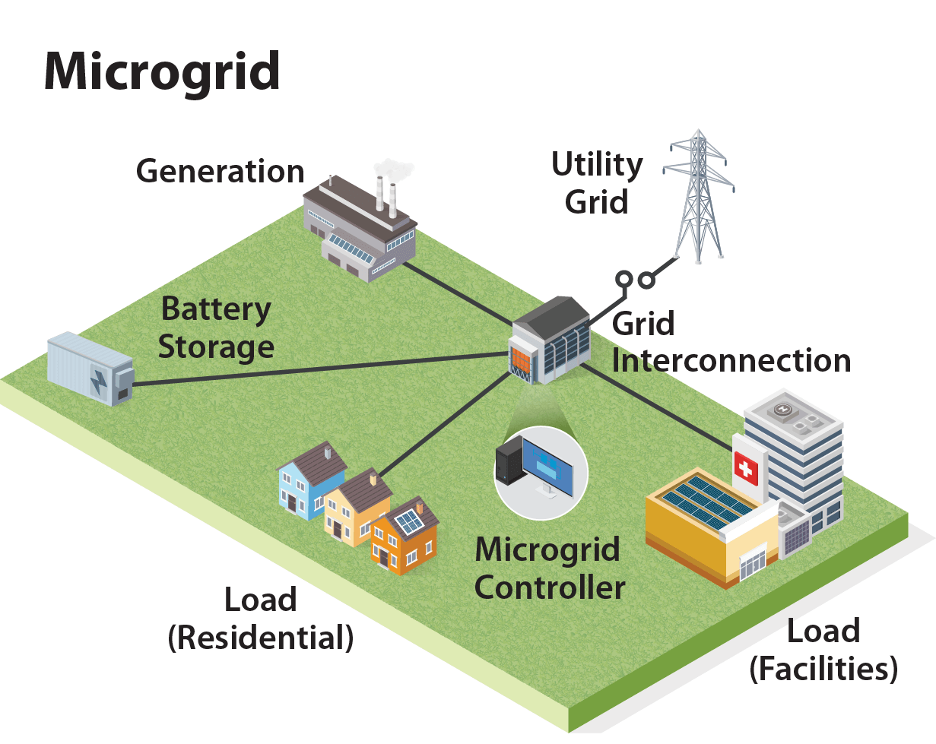
In simple terms, a microgrid is a system that uses local energy generation to serve local energy loads. They can operate in “island” mode, meaning the only energy being used within the microgrid area is that which is generated and/or stored locally.
Microgrids can take many forms and range in scale, from a single building with a diesel-generator to an island community with a solar field and large batteries to store the power for later use. Many microgrids operate as grid-connected during everyday conditions; the power being used comes directly from the larger grid infrastructure and is generated from afar. These forms of microgrids only switch on for backup power or resilience purposes, like during a large-scale outage from a hurricane or a downed tree on a transmission line. Others are designed to operate independently at all times, particularly in remote or isolated locations. These are completely “off grid” systems.
Across these settings, microgrids are used to improve reliability, support critical services, integrate local energy resources, and maintain power during grid disruptions.
Although their designs vary, all microgrid systems share four core components:
- Local Generation: Energy resources are generated on site.
- Electrical infrastructure and controls: Switchgear, protective devices, interconnection, and control systems; they define the boundary of the microgrid and ensure that the system can safely be switched on and off. When it comes to energy, safety is of utmost concern.
- Loads: Energy demand needed at the location(s).
- Storage: Batteries are commonly used to store, stabilize, and release energy.
Microgrids in Maine Communities
Microgrids are uniquely suited for addressing the challenges of Maine’s energy landscape—particularly for island, coastal, and other end-of-the-line communities that regularly experience unreliable energy. Many of the communities Island Institute works with already have or are interested in developing microgrid systems precisely because of the resilience benefits they offer.
“The reasons to invest in microgrids, especially on islands, run the gamut from wanting a place to cook a warm meal during an outage to being concerned about what happens to fuel deliveries after a storm surge.”
Although larger microgrid systems on the mainland are less common, we’re already seeing small coastal communities with histories of challenging reliability invest in solar and battery systems for community buildings. During prolonged outages, those buildings can act as hubs to meet community needs; people know they will be able to charge a phone, use a medical device, and stay warm or keep cool.
Deer Isle, Stonington, and South Thomaston already have or are actively working on developing these resilient energy systems. Other communities, like Monhegan and Matinicus, operate off-grid systems out of necessity, as they have no submarine cable to connect them to the mainland grid. For different reasons and use cases, microgrids are already common in Maine.
Microgrids offer opportunities for communities to take active steps towards improving outcomes during severe storms. The reasons to invest in microgrids, especially on islands, run the gamut from wanting a place to cook a warm meal during an outage to being concerned about what happens to fuel deliveries after a storm surge.
Beyond that, people are concerned that they won’t be able to age in places without reliable power. They worry that folks won’t want to move to their community, keeping it a year-round island, because of the fear around losing electricity for prolonged periods of time during the coldest months of the year. Having a space in these communities with energy generation, storage, and even fossil fuel backup can set folks’ minds at ease.
While microgrids have many benefits, they are still complex electrical systems within a complex regulatory landscape, making the intricacies of microgrid planning considerably daunting. Microgrids require a significant amount of pre-feasibility support even before having an engineer step foot on site. Island Institute meets this need through technical assistance programs, like the U.S. Department of Energy’s Energy Technology Innovation Partnership Project (ETIPP) and Community Microgrid Assistance Partnership (C-MAP). Learn more about these programs here.
Looking Forward
Microgrids are quite the buzz around energy-challenged communities—and for good reason. They’re a great tool to have in a community’s toolbox, but the microgrid itself is not the start nor the end of the conversation. It requires lots of planning to take this tool on and reduce the costs (which are significant) before the project can even break ground.
If your community is thinking about energy resilience strategies, a formalized strategic energy plan is a great place to start. Understanding your community’s energy use, challenges, goals, and potential projects while building momentum around energy work goes a long way in project success. Take a look at low-hanging fruit to address affordability, reliability, and resilience: energy efficiency, weatherization, and vegetation management are great places to start. With programs like ETIPP and C-MAP, Island Institute can support communities interested in thinking through this resilience investment.
Maine’s energy landscape of the future could have microgrids sprinkled up and down the coast, spanning from single building resilience hubs to downtown centers and working waterfronts. In the meantime, Island Institute will continue doing what we do best: supporting innovative solutions for island and coastal communities.