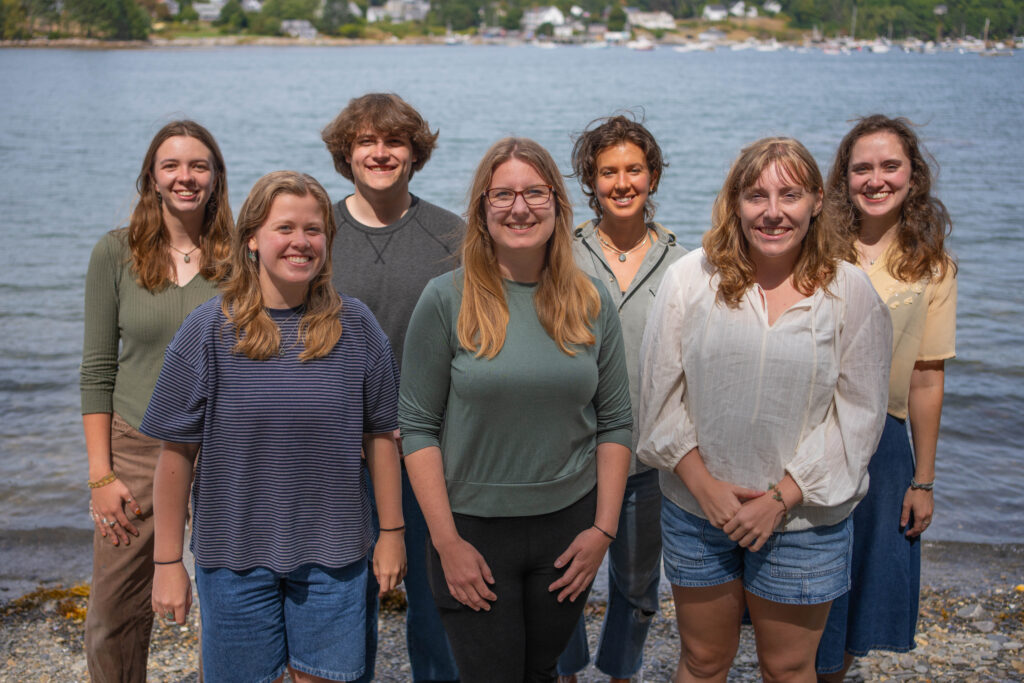
In Maine, the end of August sees some people leave the state while new ones arrive. For our organization, the new arrivals are Island Institute Fellows: early career professionals moving to island and coastal communities for a year or two of deep-seated community development work.
Maine’s coastal towns can apply to Island Institute to request a Fellow to work and live in their community. They must show need, community buy-in, and a work plan for a project in the areas of climate resilience, marine economy, and/or affordable housing. Island Institute then accepts applications and, in collaboration with the host community, hires Fellows who will take on that essential work. This past year, over 120 people have applied for the open Fellowship positions, bringing talent, drive, curiosity, and capacity to some of the Maine coast’s more remote areas.
In early September, Island Institute was delighted to gather Fellows continuing into their second year and other staff to welcome new Fellows for a 3-day orientation at Blueberry Cove 4H camp in Tenant’s Harbor. After orientation is complete, the Fellows either returned or moved for the first time to their host communities.
While bittersweet to have said goodbye to Fellows that so recently finished their terms, it is always exciting to welcome the new cohort. Learn more about more about our new and returning Fellows below.
New Island Institute Fellows
 Ted Arnold (Chebeague, Town of Chebeague): Ted joins the Town of Chebeague to take over from previous Fellow Lorren Ruscetta. Ted will support community engagement and committee work as the town continues updating their Comprehensive Plan. He moves to Chebeague from Washington DC, where he received his bachelor’s degree in political science at George Washington University and recently completed an internship with the National Housing & Rehabilitation Association.
 Alifaire Noreen (Blue Hill, Town of Blue Hill): Alifaire will be the on-site project coordinator for a national Safe Streets grant to increase safety of non-vehicular traffic to Blue Hill’s downtown area by managing grant deliverables, liaising with community members, and coordinating between the steering committee, consultants, Select Board, town staff, and the greater community. Additionally, Alifaire will explore two infrastructure projects with Fire Station and Wastewater Treatment Plant—both at risk of sea level rise. Alifaire grew up on an island off the coast of Washington and comes with a Master of Science in environment and sustainability from the University of Michigan.
 Kaylee Neat (Cranberry Isles, Town of Cranberry Isles and Cranberry Isles Community Solar Association): Kaylee works with the town and the Cranberry Isles Community Solar Association in various sustainable energy projects. This work includes collaborating on the energy portion of the comprehensive plan, assisting the Town in the Dark Sky Initiative, and exploring feasibility for an electric microgrid for the Cranberry Isles working waterfront. Kaylee is a Maine native and recently moved back after completing her master’s degree in geochemistry at Penn State.
 Emma Butterfield (Isle au Haut, Isle au Haut Community Development Corporation): As a Fellow, Emma primarily works with Isle au Haut’s Community Development Corporation in growing and maintaining affordable year-round housing on the island. Her work will include creating a records management system, digitizing files, helping with existing property maintenance, and exploring funding options for future housing and waste management projects. This project may later include supporting zoning and funding for a road that leads to a parcel of land that may be used for future affordable housing units. Also from Maine, Emma is a Bowdoin graduate, where she completed a dual degree in environmental studies and Hispanic studies.
Returning Island Institute Fellows
 Elizabeth (Liz) Dudley (Monhegan, Monhegan Plantation): Liz continues to collaborate with Monhegan Plantation on a working waterfront resiliency project as the plantation redesigns their public wharf and breakwater as well as shores up other waterfront access areas. The plantation engaged the engineering firm GEI for designs on both infrastructure projects and now moves forward to final designs, permitting, and funding. With Liz’s added capacity, the municipality has been able to engage residents from business owners and fishermen to summer community members. Liz came to the Island Institute from Atlanta, Georgia, where she completed her master’s degree and worked as a policy researcher.
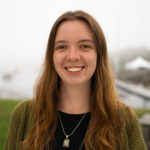 Emerson Wesselhoff (Damariscotta, Town of Damariscotta): From the Town Office of Damariscotta, Emerson works with the Town Manager (Fellowship Alumnus, Andy Dorr) in implementing the comprehensive plan. Emerson facilitates the town’s implementation plan committee and has also led on projects re-envisioning the downtown road corridor, setting up an EV policy, and the health and capacity of the Damariscotta River. In 2025, Emerson graduated from Kalamazoo College in Michigan, where she engaged in climate action with the college, city of Kalamazoo, and had community engagement experience while abroad in Thailand.
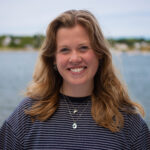 Elizabeth Dyer (Islesboro, Islesboro Energy Committee and Islesboro Community Center): Elizabeth directly supports Islesboro’s energy committee assessing the success of recent energy transitions at the home and municipal level and Islesboro’s participation in the federal Energy Technology Innovation Partnership Program (ETIPP). Through the community center, she engages school students around climate and energy awareness by starting with topics that they’re already interested in. In 2025, Elizabeth graduated from Allegheny College in Pennsylvania where she studied environmental science and sustainability.
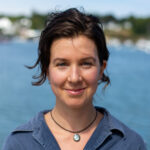 Katherine (Kate) Cart (Phippsburg, Marine Resources Working Group): In her first year, Kate has immersed herself in understanding access to clam flats and other fishing access and started to move the needle on the narrative of local fishing in the community. In addition, she’s collaborated with local schools to provide students with opportunities to engage with local aquaculture. Kate is a writer and you can read her blog about Phippsburg’s fisheries here. In 2025, Kate returned to her home state of Maine after completing a Fulbright in Canada on “North American Fisheries in Flux: Narratives of Coastal Ecosystems, Economies and People.”