On a wet afternoon in mid-November, I met Phippsburg clam digger Terry Watson and his son Casey on a back road in town. Since I started my fellowship last September, Terry and Casey have been teaching me about the wild shellfish harvest. When I pulled off the road, they were already there, waiting in Terry’s white truck. I poked my head out and yelled that I hoped they weren’t waiting on me. “Waiting out the rain,” Terry replied.
We were aiming for a pretty little back cove, the inland-most edge of long, snaking mudflat. The day was overcast, lightly drizzling. There was a gale forecasted for the coming days, a smacking of the cold season to come. I joked that I thought Terry had said he was too tough to quit for a little rain, getting a laugh out of Casey.
“We might see some milky ribbon worms,” Terry said, explaining that he thinks they’re more common in protected shallower flats like ones we were aiming for. When I mentioned that I hadn’t yet come across the milky ribbon worm—in conversation or in person—Casey started laughing. “Could be made up,” he joked.
Terry just grinned. “If you cut the worms in half, they don’t die,” he said. “You just get two worms.” The tidiest, most ecologically friendly option, is to feed them to the gulls.
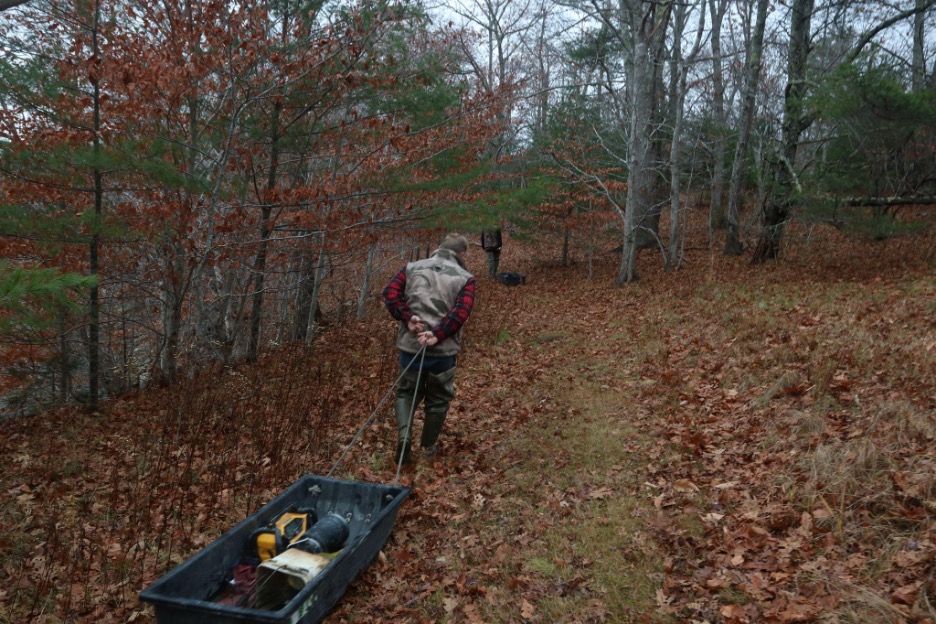
We pulled on our boots and trekked through the woods on a path thick with fallen leaves. This was great PR, we quipped: two generations of clammers! Then Terry shifted focus to Casey’s burgeoning comedy career. In the last few years, Casey has started blowing up in the New England stand-up comedy scene. I’ve even seen him take the stage at a sold-out show in Portland! In person, however, out there in the woods and on the flats, I chatted mostly with Terry.
The connections between the topics Terry and I talk about aren’t always obvious. But that’s the basis of good thinking—and writing: connecting dots that haven’t yet been. The blistering pride Terry has for his three sons, their diverse careers, and work ethic is a constant in our conversations. At the moment, clamming and comedy are inextricably linked in Casey’s life.
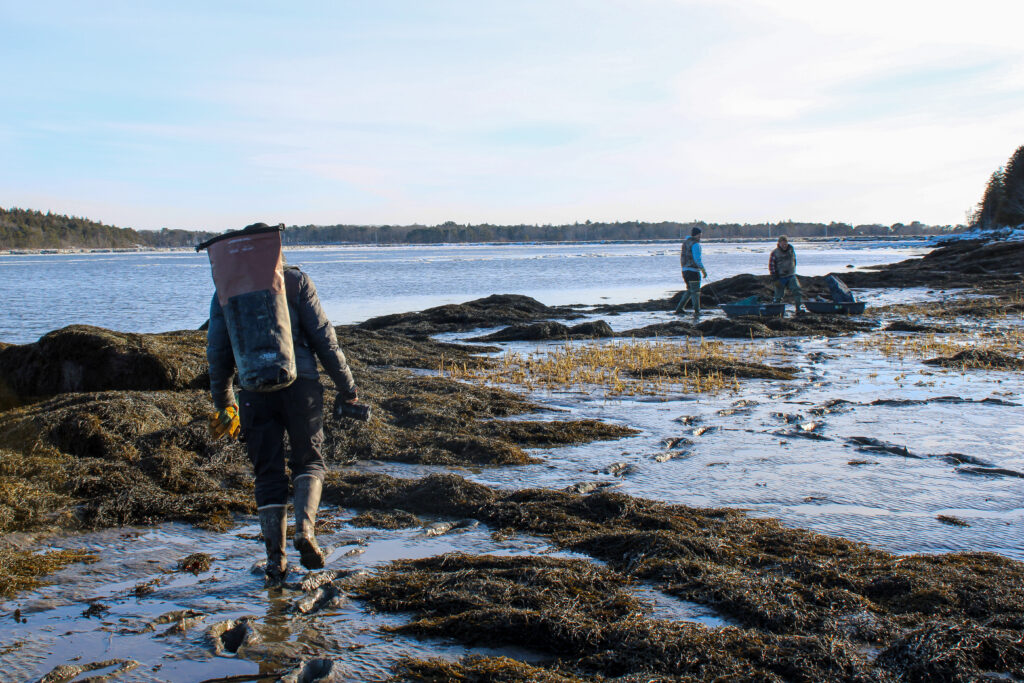
It was a short walk to the flats. Up on all the ridgelines, large houses loomed through the trees. He and Casey don’t usually dig on this side of Phippsburg, Terry said, but that week, the Kennebec River side had been rife with problems and bad digging. While we walked, Terry talked about other shore access points, some of which new owners have banned from use, effectively cutting diggers off from their workplace and nixing historical fishery trails.
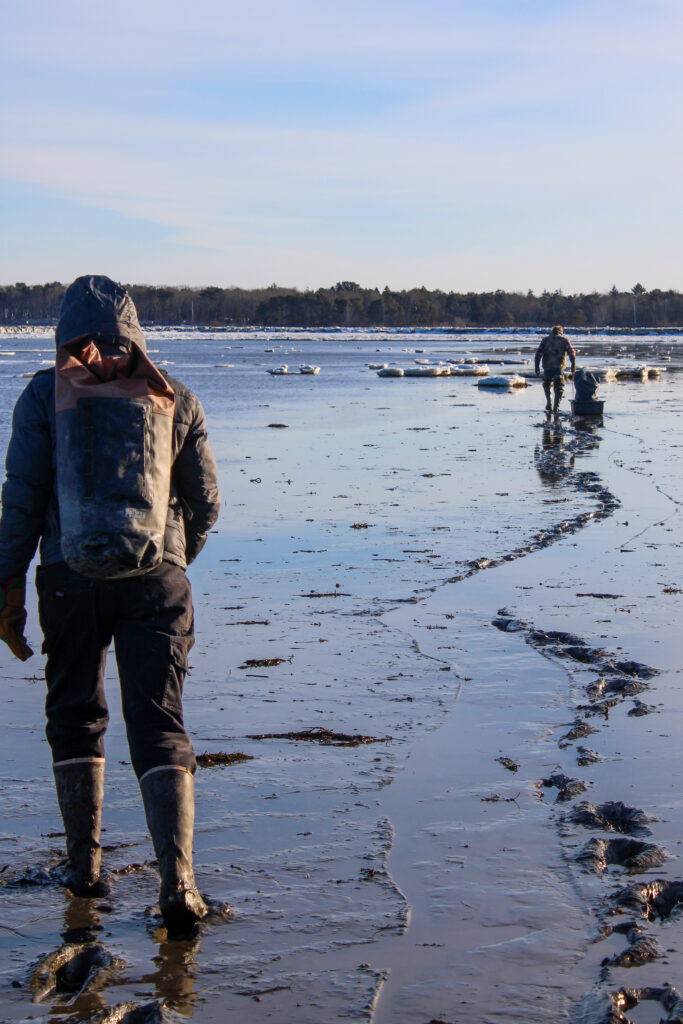
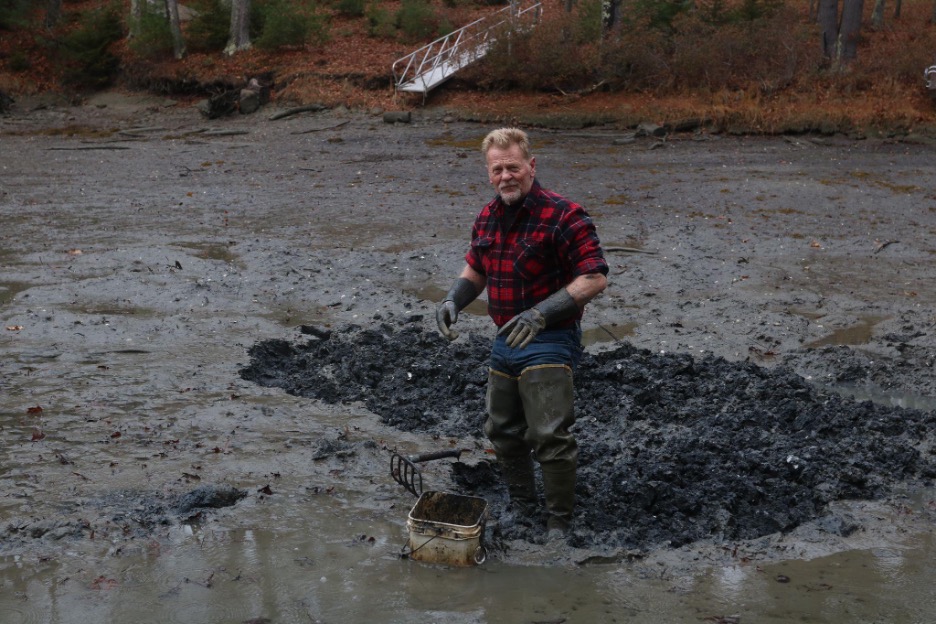
Then we were on the narrow flats, with the last of the tide slipping out on a serpentine river. The hip boots I wore were a bit too big. Even with a couple pairs of thick socks, they were loose enough that the mud held on to them, deepening the sense of imminent sinking. Casey marched straight across the ebbing river and started digging beside a large fallen birch. If there’s a phobia of quicksand-like mud, I think I might have a touch of it. So, leery of the wetter mud and sparing Casey my camera, I followed Terry, who was maybe starting to get used to me chattering away and snapping his photo while he works.
The mud is strange. It’s not water and to me, it doesn’t quite feel like land. But I imagine to someone like Terry, who’s been digging for over half a century, it feels so familiar that he doesn’t need to think about it much. It’s one dynamic detail in the daily routine of a multidimensional career. Maybe the physical sense of walking through the mud is somewhat like the physical sense that I have while typing. Since I started writing, the longest time I’ve taken away from a keyboard was a month, for a rafting trip. Besides the welcome return to the conceptual act, the physical sensation when I sat down again and began to type was memorably wonderful. I imagine walking the mud is somewhat like this; a forgettable, yet inherent detail of a clammer’s day. Humans just aren’t that complicated. Our days follow the same basal patterns, just given different details and names.
The mud is strange. It’s not water and to me, it doesn’t quite feel like land. But I imagine to someone like Terry, who’s been digging for over half a century, it feels so familiar that he doesn’t need to think about it much. It’s one dynamic detail in the daily routine of a multidimensional career.
Terry looked up from flipping the mud and squinted at me struggling along in the over-sized boots. He gave me three succinct pieces of advice: Take small steps. Step on the ball of your foot. And if you get stuck, twist. No surprise, these details of movement, second nature to Terry, were miraculously useful tips. I walked––if not gracefully, then less like a struggling fawn.
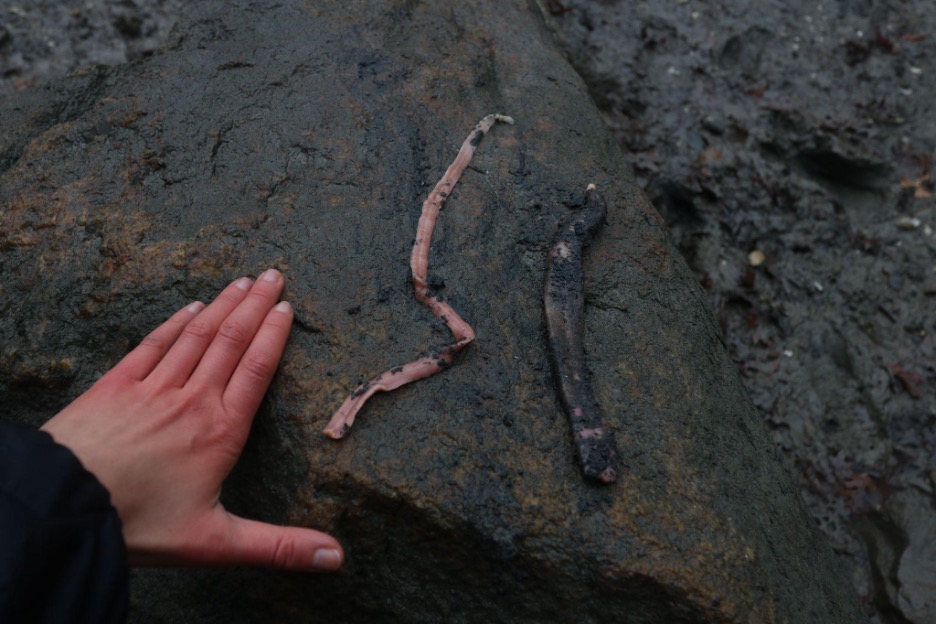
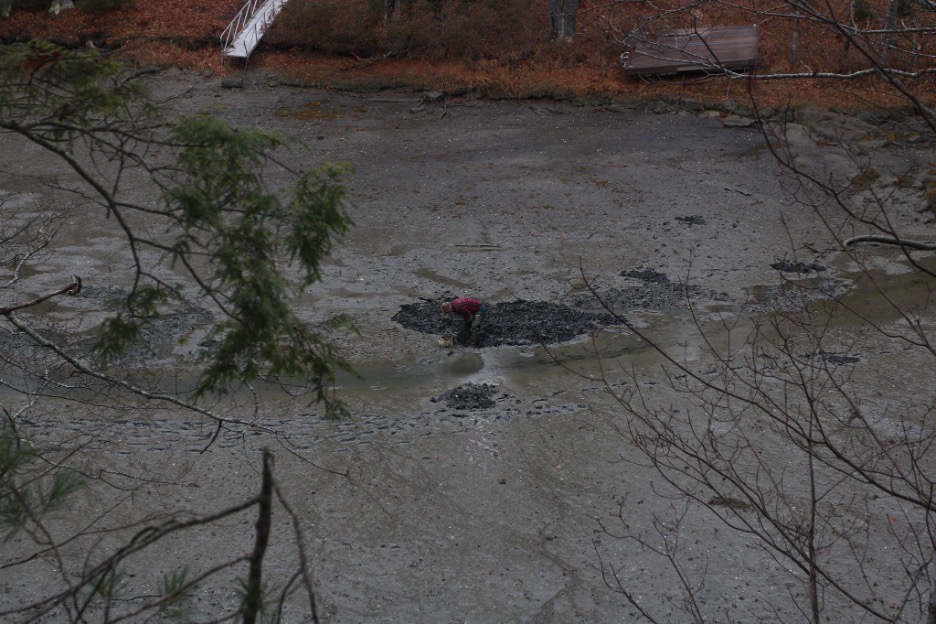
Eventually, I climbed back up through the woods to get a shot that included both father and son. While I was up on the embankment, Terry started calling my name. He’s got quite the set of lungs and the cove we were in had great acoustics. My name echoed as though from speakers. I called back and Terry turned, scanned the bushes until he saw me, a rain-damp ghoul, squatting with a camera. He held up a fist. From it dangled a long, muddy, pinkish ribbon.
I scrambled back down the hill and Terry crossed the mud. He laid the fleshy ribbon on a rock—now severed in half but still writhing. It looked like the living tongue of an anteater. It was, in fact, a milky ribbon worm.
Looking down at this intertidal creature, Terry and I started talking about the complexities of the problems impacting Phippsburg’s clam populations. Wild clam beds are declining in some areas. Harvesters are struggling to access those that are still productive. Though hyper-local empirical research is lacking, a recent study indicated a decline in wild softshell clam of nearly 90% in the upper reaches of the Damariscotta River, just miles east of Phippsburg. These changes are perhaps reflected in the number of Phippsburg’s commercial diggers: In 2011 there were 40 license holders. Now there’s 17.
A recent study indicated a decline in wild softshell clam of nearly 90% in the upper reaches of the Damariscotta River, just miles east of Phippsburg. These changes are perhaps reflected in the number of Phippsburg’s commercial diggers: In 2011 there were 40 license holders. Now there’s 17.
Terry mentioned how invasive green crabs get all the attention, but that he’s certain they’re not the main culprit. Instead, as with everything, there’s an enmeshed web of causes. He cited climate change and warming waters, loss of shore access, and the growing presence of predators like the milky ribbon worm whose numbers, he feels, may be increasing with the warming of the Gulf of Maine. “They never used to be far up the Kennebec.” But now, it seems, there’s more.
Harvesters note that compounding all of this is increasing difficulty in regulatory collaboration. It’s this last issue that keeps coming up in my conversations with clammers, lobstermen, scientists, and even employees of the Maine Department of Marine Resources (DMR): a sense of a broad systematic struggle impacting everyone. In chatting with DMR employees, I hear that they’re also overworked, underfunded, and sensing a frustrating gap in communication as much as anyone. As ecosystems and our understanding of them change, new regulations pile up to try to contend with all this shifting. Researchers, fisheries advocates, and policy makers all echo the same thing: The rate of change is increasing on this coast. It seems nobody quite knows how to keep up. That doesn’t stop a lot of people from trying.
Researchers, fisheries advocates, and policy makers all echo the same thing: The rate of change is increasing on this coast. It seems nobody quite knows how to keep up. That doesn’t stop a lot of people from trying.
It’s useful to isolate problems. But what happens when we isolate the conversations about those problems, too? What if problems—and the people experiencing them in different ways—had greater overlap in conversation? This is the benefit of thinkers like Terry, whose creative brain makes the synaptic leaps others’ might not. Personally, I think this is a benefit of careers like clamming. The time to think freely expands out on the mud—something that a barrage of, say, emails can chop up into frustratingly little pieces.
When it was time for me to head out, I yelled goodbye to Casey, who was digging a good patch across the cove. He had earbuds in and didn’t hear me. On the other side of the cove, Terry said, Casey was likely listening to comedians—not to laugh, but to learn the craft of it.
I get it. I’ve worked all sorts of jobs. Many of them felt like simply a means to the end that was writing. But looking back now, all those jobs were full of details that taught me about the overlaps of people, systems, and life.
When I got home, I looked up the milky ribbon worm. The Downeast Institute has supported some great research on this quiet creature. The worm preys on clams with a long tongue-like proboscis, which snakes into the exposed clam’s body and injects a toxin to liquefy the already soft clam flesh. The worms typically target larger clams, often those above the two-inch market size, thus limiting the clam populations that are available to diggers. And, just as Terry has hypothesized, as waters warm and shellfish become more vulnerable, predation of soft shell clams by invertebrates might be increasing too. But still, so much of this muddy benthos is understudied. Brian Beale of the Downeast Institute told me that milky ribbons worms are the bane of his research—wily, silent, uncharismatic creatures, they’ve largely escaped total understanding (if such a thing is ever possible).
There are all sorts of ways to communicate. Through generations and with strangers. With writing and photographs. Bellowing across mudflats. By making people laugh. As much as I wonder about gaps in communication, I’m also witnessing amazing and unexpected new links between ideas and people.
Later in the day, Terry texted me. A gull had made off the two halves of the milky ribbon worm. He also asked if I’d seen the piles of empty quahog shells scattered around the edge of the flats. “Hard to believe that the seagulls find that many quahogs,” he said. Just like unexpected advice on how to walk, these ecological observations are crucial to me. They begin to fill in the pretty image with meaning.
The mud is alive with things I will never see and systems I will never know. But just because I don’t know them does not mean that they don’t exist. The trick of this Island Institute Fellowship, I’m finding, is to first figure out who my teachers and my audiences are, then learn the best ways to listen and talk to them. There are all sorts of ways to communicate. Through generations and with strangers. With writing and photographs. Bellowing across mudflats. By making people laugh. As much as I wonder about gaps in communication, I’m also witnessing amazing and unexpected new links between ideas and people, whose patient collaborations here in Maine’s Midcoast are already solving issues we once thought too complex.