
As Island Institute’s fourth annual Convening on Marine Electrification came to a close, a Florida-based motor manufacturer wrapped up our rich discussion with a beautiful observation. He and his colleague stopped at the Maine Maritime Museum on their drive up to Camden where he was struck by Maine’s long-standing heritage not only of shipbuilding, but of innovation. Mainers continued to build ships as sail power evolved into steam power and steam power into internal combustion. And now, he remarked, it’s perfectly fitting that Maine is a leader in this new chapter of marine propulsion: electric.
Our convening brings together boatbuilders and designers, boatyards and marine service providers, members of the supply chain, standards and policymakers, utilities, and advocates. The group meets annually to build networks, maintain momentum, and steer Maine’s marine electrification movement. The convening is part of Island Institute’s commitment to position Maine as a national leader in electric boats, strengthening the resilience of our businesses and working waterfronts. This year’s convening was extra special because it served as a pre-conference kick-off to Maine’s inaugural Electric Watercraft Forum.
The Electric Watercraft Forum (EWCF) was a two-day event held at Lyman-Morse Boatbuilding in Camden. About 130 people attended and engaged in the tradeshow, five case study panels, electric boat rides, an energizing keynote address by Phil Coup, and a gorgeous, harbor-side sunset reception. As the electric boat market experiences rapid growth, the EWCF is an opportunity to further propel that growth through education, exhibition, and experience.
The convening is part of Island Institute’s commitment to position Maine as a national leader in electric boats, strengthening the resilience of our businesses and working waterfronts
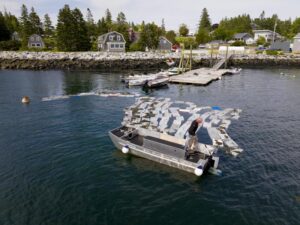
The first case study featured Isobel, a sleek and sporty 26-foot runabout designed by Stephens Waring, built by Belmont Boatworks, and powered by RAD Propulsion. Next, I moderated a panel with Island Institute’s Lia Morris, Patrick Fogg of Fogg’s Boatworks, and Tom Watson of ePropulsion to discuss Wattson, the Spruce Head Fisherman’s Co-op’s electric skiff. Immediately following, Lia sat on another panel to dig into charging infrastructure planning and funding challenges. On Friday, we learned how difficult it is to build an electric Coast Guard certified vessel, which requires a strict set of requirements to keep crew and passengers safe in the event of a worst-case scenario. These early projects result in so many lessons, showcasing the value of a knowledge sharing platform like the Electric Watercraft Forum.
The forum concluded with a lovely study of various Hylan & Brown electric retrofits. As Maine begins a new chapter of purpose-built, highly efficient electrified hulls, it’s also important to remember our wooden boatbuilding heritage. Hylan & Brown specializes in repowering classic wooden boats with modern electric motors, so that their owners can enjoy the serene beauty of Maine’s coast while slowly whirling from place to place.
The boats featured in these case studies were all built in Maine by accomplished welders, skilled designers, marine electricians, and traditional woodworkers. Fittingly, workforce development was a major topic during our convening and throughout the forum. It is seen as a barrier to the growth of marine electrification in Maine. Recruiting and training the next generation to build, fix, design, and maintain our boats is paramount. The closing of the Landing School, a boatbuilding and design school in southern Maine, was a hot topic. What will fill that gap?
Workforce development was a major topic during our convening and throughout the forum. Recruiting and training the next generation to build, fix, design, and maintain our boats is paramount.
Another major discussion at ECWF was how expensive electric boats can be, and the opportunity for funding and incentives. Rebates and incentives have facilitated the adoption of solar, heat pumps, and electric cars in Maine, and the long-term goal of our work is that federal and state policies will support the adoption of electric boats in similar ways. There are existing programs that accept hybrid or electric repowers, like Maine’s Clean Diesel Grant Program, and there are programs that could be adjusted to include electric boats, like USDA REAP. And then there is the chance for new programs and pilot projects that could benefit a larger array of individuals and businesses.
By bringing these groups together, we’re moving an industry forward.
Island Institute’s annual convening and the new Electric Watercraft Forum are an opportunity for the industry to shape how these barriers should be tackled. By bringing these groups together, we’re moving an industry forward. Thanks to this work, there might be a time when electric propulsion stands next to the other greats at the Maine Maritime Museum, demonstrating how heritage continues to go hand-in hand with innovation.
The Electric Watercraft Forum was founded by Kate Holden and Ellery Brown with Island Institute as a founding partner. It was hosted by Lyman-Morse and supported by the International Electric Maritime Association.