
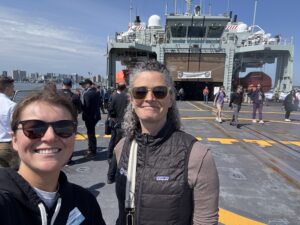
It’s not uncommon for an Island Institute employee to hop on a ferry to one of Maine’s unbridged islands. But in early June my colleague Lia Morris and I boarded The Cat, a fast ferry bound for Yarmouth, Nova Scotia. Our final destination was Halifax to learn from our Canadian peers about efforts to electrify their lobster fishery. Lia and I lead Island Institute’s electric boat work, which is focused on developing for commercial electric boat adoption. The goal of the visit was knowledge exchange: to establish Maine as a leader in marine electrification, while learning from what others are already doing. Support for this work is provided in part through Builders Vision and Reed J. Stockman.
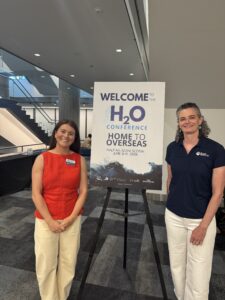
Our visit included the Home 2 Overseas (H2O) conference, where we presented on electrifying Maine and Nova Scotia’s workboats with Brent Dancey of Canadian nonprofit Oceans North. The session highlighted different approaches to electrification from two organizations with similar community and climate missions. Island Institute is building the ecosystem to support electric boat adoption, launching smaller demo boats along the way, and setting the groundwork to hybridize a lobster boat. With significant funding in hand, Oceans North, in partnership with First Nation Membertou, are building an electric lobster vessel so that when conversations about electrification happen, policymakers and industry stakeholders have something tangible to point to. Both approaches take time, resources, and visionary people.
Nova Scotia is tackling the exact same challenges we are in Maine, just with different funding streams. It also reinforced something I’ve felt for a while: the most productive conversations in this space happen when the full supply chain is in the room.
Lia and I had the privilege to hear from some of these visionaries during an enlightening roundtable discussion featuring partners involved with – or just interested in- the electric lobster boat. Familiar themes emerged, such as supply chain barriers, the need for a coordinating entity to navigate the hurdles, and demand for an upskilled workforce. While some of the regulatory or funding hurdles may differ from Canada to the US, the desire for reliable, quiet, and powerful propulsion resonates across borders.
Lia reflected on these shared obstacles, saying: “My biggest takeaway was that Nova Scotia is tackling the exact same challenges we are in Maine, just with different funding streams. It also reinforced something I’ve felt for a while: the most productive conversations in this space happen when the full supply chain is in the room—not just the boat owners, but the builders, the systems engineers, the lenders, state or government representation, and the infrastructure people.”
We’re laying the foundational support for marine electrification by addressing the barriers commercial operators face – like charging, workforce, and funding. We’ve learned so much with each electric demonstration boat, while setting the table for future successes.
I’m impressed with the work Oceans North is doing: Building a fully electric lobster vessel is an incredible step forward, and a huge learning opportunity. It has also made me really proud of the incremental work we’ve done in Maine to get to this point. We’re laying the foundational support for marine electrification by addressing the barriers commercial operators face – like charging, workforce, and funding. We’ve learned so much with each electric demonstration boat, while setting the table for future successes.
We concluded our visit with the Cove Demo Day, which brought together marine and dual-use technology leaders for live, on-the-water demonstrations. While the demos focused on defense technologies, like robots and remotely operated vehicles, something in the opening remarks stood out to me: “Innovation doesn’t happen in isolation.” It’s a simple yet important reminder that taking the time away from our desks and to build to connections is essential for our bold vision of electrifying Maine’s coast.