
On Thursday, November 5, NOAA Fisheries published an announcement that upcoming Atlantic Large Whale Take Reduction Team (TRT) meetings would be delayed until March 2027. The delay comes with the intention of allowing more time for new science and data to move through the scientific peer review process. These updates to a complicated process will likely result in important and positive implications for Maine’s lobster fishery.
Great, NOAA has delayed a meeting. Why is this significant to Maine? First, it’s helpful to understand some background.
North atlantic right whales and the trt
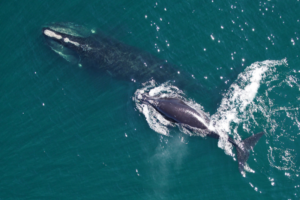
NOAA Fisheries is federally mandated to protect the endangered North Atlantic right whale under both the Endangered Species Act (ESA) and the Marine Mammal Protection Act (MMPA). As part of these requirements, there is a large and often complex process that involves assessing right whale population dynamics, the risk posed by fishing gear (specifically vertical lines from fixed gear used by lobster and crab fisheries), and scientific modeling. This information is used to develop what is known as the Atlantic Large Whale Take Reduction Plan.
During the last round of proposed right whale regulations, which were paused from being implemented by Congress, Maine’s lobster industry was facing a very high burden of risk reduction to right whales. The plans put forward would have meant fundamental changes to the way the fishery could fish, as well as large-scale closures of fishing grounds during important times of year. It was expected that if these proposed regulations had gone into effect, there would have been significant impacts on the economic viability of the Maine lobster fishery and economic hardship in communities—particularly in Downeast Maine. This is an issue that the Maine lobster industry has been concerned about for years, given the potential effect these regulations could have on individual lobster businesses and the industry at large.
It was expected that if these proposed regulations had gone into effect, there would have been significant impacts on the economic viability of the Maine lobster fishery.
The TRT—which is comprised of representatives from across many stakeholder groups—develops proposed regulations that meet risk-reduction targets set by NOAA Fisheries and informs the Take Reduction Plan. The TRT process is where various changes by the lobster fishery to help protect right whales—like weak links, sinking groundlines, trawling up, and gear marking requirements—originated.
Why is there a delay? is this a good thing?
The announcement clearly states NOAA Fisheries’ intention to use the best available science to inform their upcoming round of proposed right whale regulations—something that the Maine fishing industry has long pushed for. The announcement identified three areas where they were updating the data or undergoing the scientific peer review process.
The first is a new scientific method for apportioning entanglements by country. Given that the North Atlantic right whale’s typical range includes Canada, other parts of the Atlantic Ocean, and the entire U.S. Eastern Seaboard, part of assessing the risk of entanglements by fishing gear to whales is determining which gear poses a risk and where it is located.
Allowing the most recent population information to be considered in the TRT process demonstrates NOAA Fisheries’ commitment to using the best available science.
Here in the Gulf of Maine, the primary focus is on lobster fishing gear. Lobster gear is considered a type of fixed gear, meaning it is stationary in the water column and doesn’t move through the water like mobile gear. Due to previous regulations that required fishermen to mark gear in unique ways, it is now often possible to determine the geographic region from which gear that entangles a whale originated. Using a new scientific method for determining the responsibility for fishing gear entanglements based on data, not assumptions, NOAA Fisheries states that the data “indicates the U.S. proportion of entanglements is around 25%, which is less than previously estimated.”
The second area of focus refers to the Population Viability Analysis model that NOAA Fisheries can use to help determine how likely it is that the North Atlantic right whale population will recover and the Potential Biological Removal (PBR). This is a determination of how many whales can be removed from the population due to human impacts and still allow the population to recover. For right whales, the current PBR is less than one whale per year.
The third area of focus refers to the delay to allow the upcoming 2024–2025 right whale population estimate and mortality estimate to be reviewed and released, which is expected later this month. Allowing the most recent population information to be considered in the TRT process demonstrates NOAA Fisheries’ commitment to using the best available science.
Implications for Maine
The final paragraphs of NOAA’s announcement contain new, important information that is particularly relevant to Maine’s fishing industry. They state that, given this new anticipated data going through the scientific review process, “NOAA Fisheries expects the estimated mortality and serious injury incidental to U.S. commercial fixed gear fisheries to be substantially lower than estimated in 2022.”
Since the last round of regulations in 2022, NOAA has collected substantial data to better understand where whales are, how whales and fixed gear interact, and the actual risk U.S. fishing gear poses to whales. NOAA Fisheries goes on to state that they expect this will be “bringing estimates within the range of PBR (i.e., the estimates of mortality and serious injury overlap the estimates of PBR and may be at, slightly above, or slightly below PBR once the process has concluded).”
While far from certain, if PBR increases enough, this could mean minor or no further regulations needed to protect right whales from fishing gear.
This means that if the new data and scientific methods pass peer review successfully and there are no other surprises, they expect the risk from US fishing gear to be at or below the allowed PBR levels.
While far from certain, if PBR increases enough, this could mean minor or no further regulations needed to protect right whales from fishing gear. The impact on PBR will likely not be known until the spring and is well worth keeping an eye on.
This announcement is an important public acknowledgment from NOAA Fisheries of the growing body of data and scientific methods developed to inform any future regulations. While further details are expected in the coming weeks, this announcement is a welcome sign to Maine industry members that NOAA Fisheries intends to use the best available science and science-backed modeling to determine the risk that U.S. fishing gear poses to the North Atlantic right whale.
stay tuned for more information
In the coming weeks, Island Institute will continue to share important updates about this topic and how it will impact the state’s lobster fishing industry. Through community engagement and policy work, Island Institute has worked with Maine lobstermen to test alternative fishing gear to gather real-world data and ensure fishermen’s experiences and perspectives informed discussions about the future of the fishery. Sign up for email updates or follow us on social media to stay in the loop. The TRT is planning to host a public informational webinar on December 2 following this announcement and the anticipated release of updated 2024-2025 right whale population data later this month.
The full press release from NOAA Fisheries can be viewed here.